Selected site-specific projects
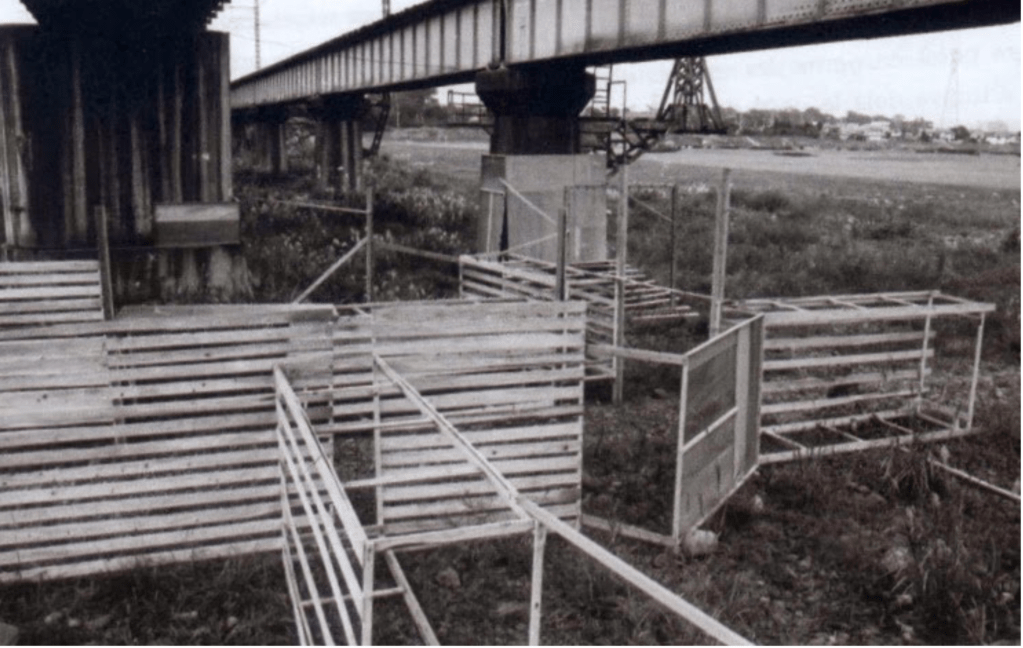
By Land
1979
Tama Riverside, Tachikawa, Japan.
By Land represents one of Kawamata’s first site-specific interventions in a public space. In the first years of his career, he was primarily working on the interior and exterior of buildings, dividing space into smaller units or passages – both in galleries with the “Measure Scenes” projects and in Japanese private apartments with the “Apartment Projects”.
“I was interested in this strip of land because of its lack of definition. A lost no man’s land. (…) I later realised that this installation anticipated the work I would go on to do.” TK
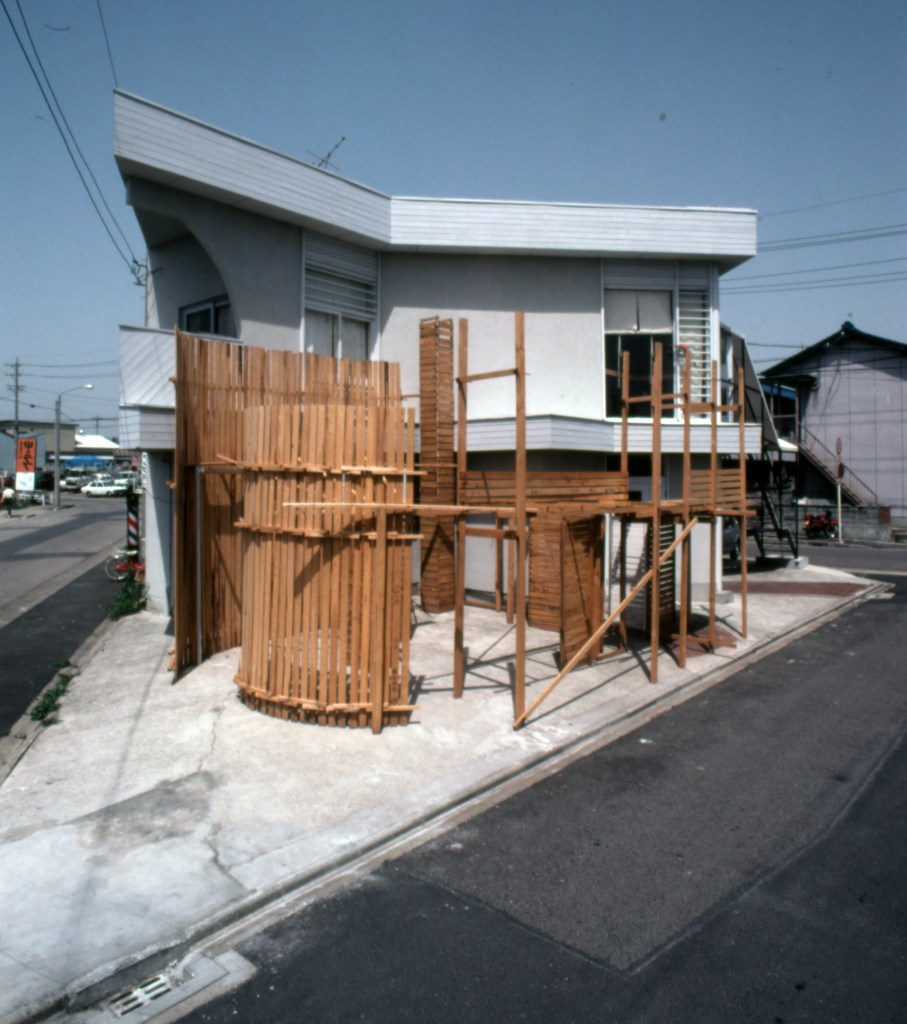
Measure Scene, Nagoya
1981
Art Space Gallery, Nagoya, Japan.
In 1981, Tadashi Kawamata created a site-specific installation at Art Space Gallery in Nagoya. The wooden structure extended from the gallery’s interior into the surrounding exterior, reflecting Kawamata’s early interest in extending art beyond the confines of traditional gallery spaces. Wall-like elements both filled the interior and subdivided it into smaller partitions, compelling viewers to navigate and engage with the work’s physical presence. As with other interventions in his Measure Scene projects presented in galleries across Japan, Kawamata’s installation functioned as a precise measure of space – a meditation on architecture, perception, and the viewer’s embodied relationship to the built environment.
“I wanted people to be able to feel the space, understand how it works, and imagine how to use it.” TK
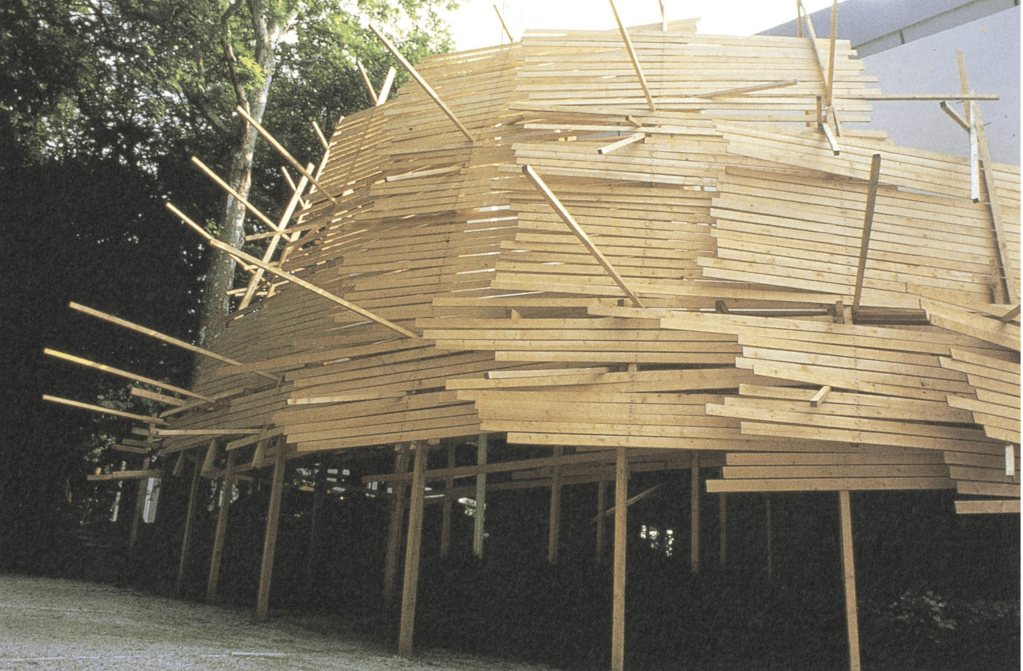
’82 Venice
1982
Japan Pavilion, 40th International Art Exhibition – La Biennale di Venezia, Venice, Italy.
For his participation in the Venice Biennale, Kawamata worked on-site for a month, assembling countless pieces of timber to create a large-scale installation that enveloped the Japanese Pavilion and extended from the surrounding woods toward the entrance. The elongated timber structures both echo and connect with the nearby trees, establishing a dialogue with the natural environment. A temporary passageway, built at the same level as the pavilion floor, allowed visitors to enter the building directly, creating a seamless integration between the surrounding landscape and the architectural space, and blurring the boundaries between inside and outside. Additionally, photo panels illustrating the planning and development of the project were displayed inside the pavilion, emphasizing that the production process itself was an integral part of the work.
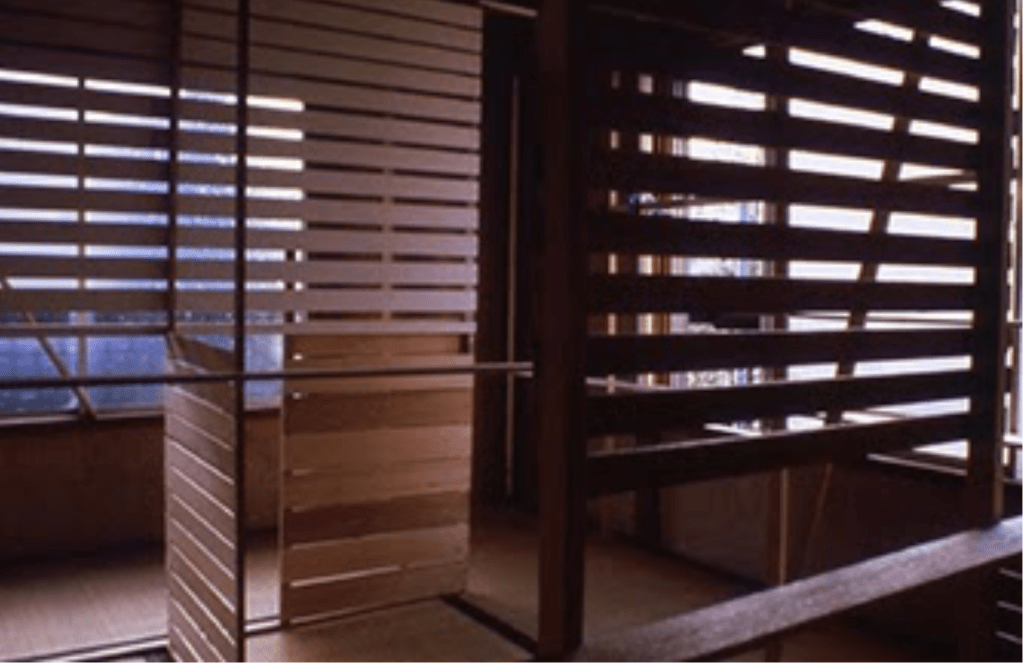
Takara House Room 205
Apartment project
1982
Tokyo, Japan.
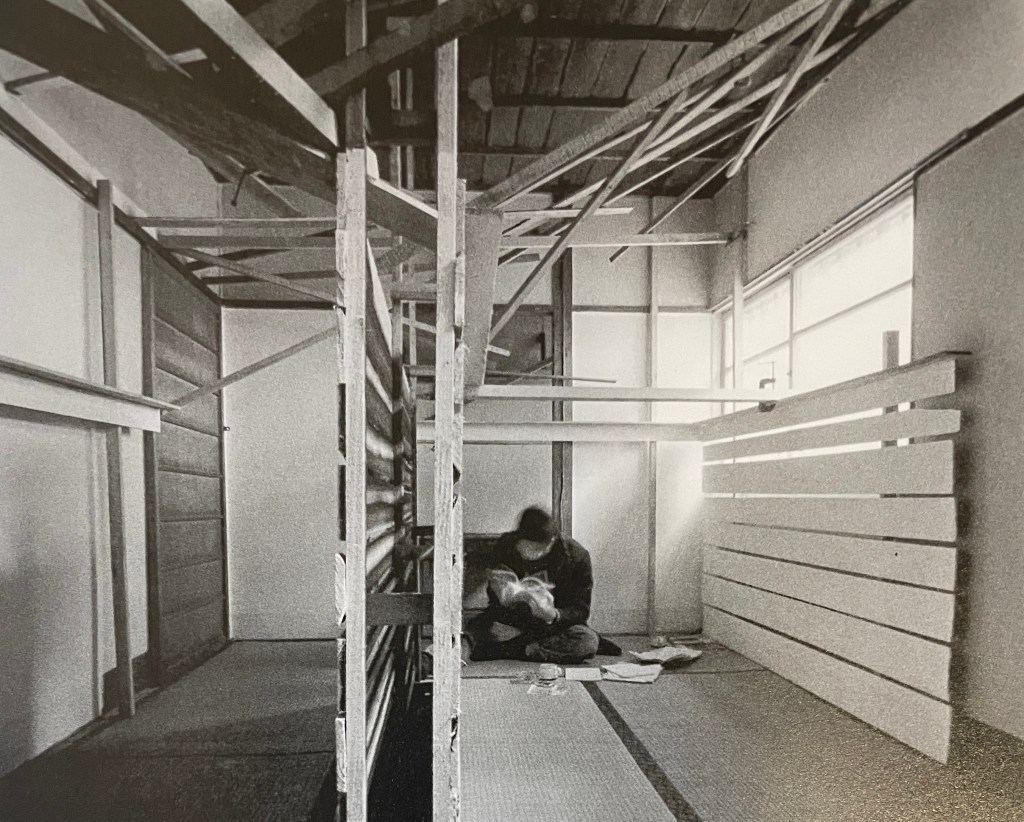
The Apartment Project began with Kawamata’s intervention at Takara House in Tokyo at the end of 1982 and continued through subsequent iterations across Japan, in Fukuoka, Tokorozawa, and Sapporo the following year, culminating in the Spui Project in The Hague in 1986. This series of large-scale, site-specific interventions marked a pivotal moment in the artist’s early career and paved the way for significant projects, including his participation in Documenta in 1987. It not only shaped the trajectory of his subsequent practice but also functioned as a crucial entry point into the international art world.
“Outside the museum and gallery circuits, I wanted to put my ideas into practice, to do what I loved. I rented apartments to carry out my own projects. They were very small, but that’s where I wanted to work.” TK
Otemon, Wada-So
Apartment project
1983
Fukuoka, Japan.
On the occasion of his participation in the group exhibition Material and Space, organized by the Fukuoka City Museum of Art, Kawamata proposed a project linking the museum and its public space with a nearby private apartment. After renting the apartment, he lived there while developing the installation. Within the museum, he assembled a structure based on the apartment’s layout, allowing visitors to form an initial understanding of the space. Following their visit to the museum, visitors were invited to the apartment and encouraged to juxtapose the imagined space with one they physically experienced, highlighting the difference between representation and reality. The project explored the potential to expand spaces of social interaction beyond conventional boundaries of public and private.
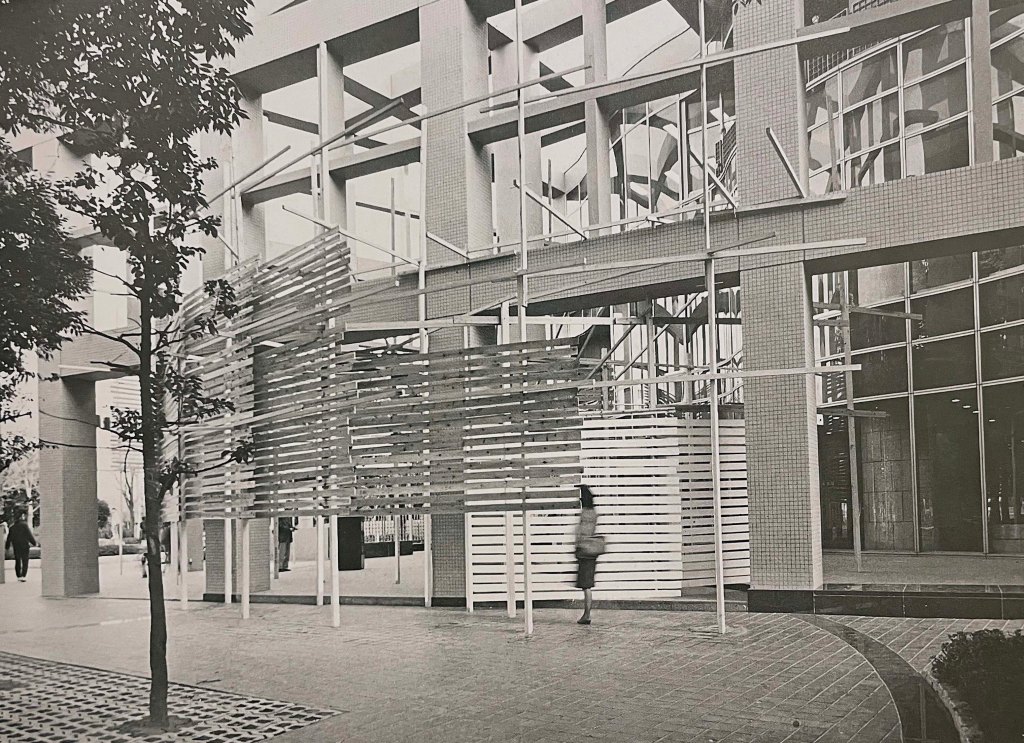
Project work in Saitama
5 February – 21 March 1983
The Museum of Modern Art Saitama, Saitama, Japan
As part of the group exhibition Shape and Spirit in Wood Works
Slip in. A Gapped House in Tokorozawa
Apartment Project
1983
Tokorozawa, Japan.
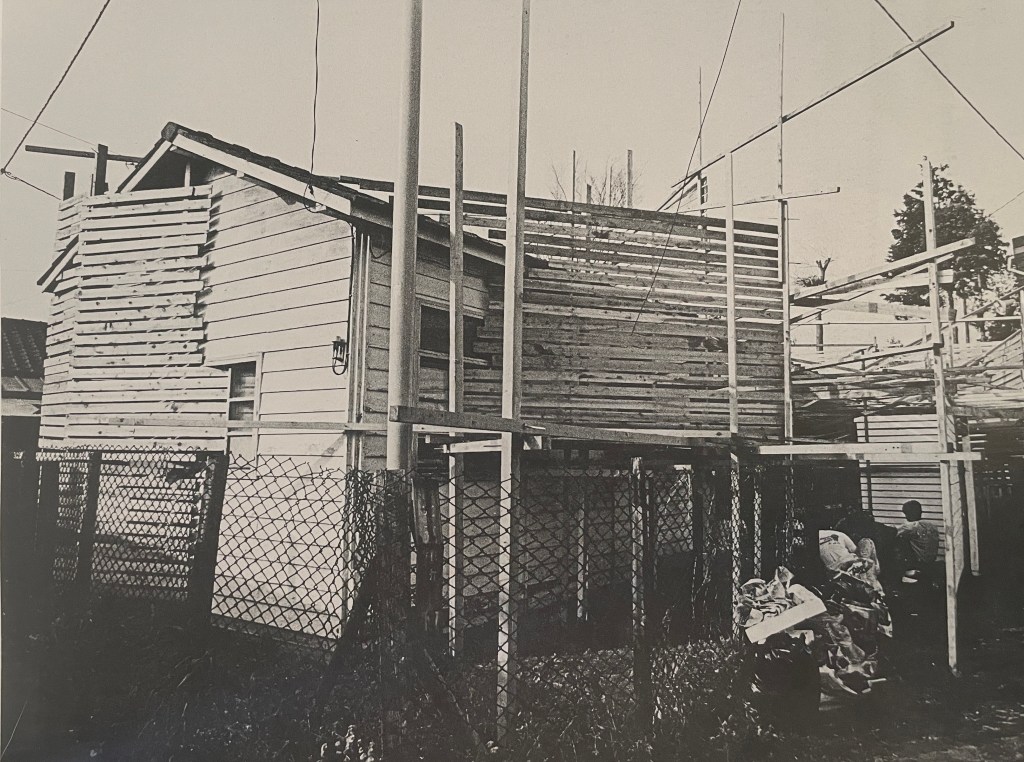
For this intervention, timber structures extended across two houses and the surrounding yard. The project highlights how the significance of an installation emerges through its relationship with the surrounding social environment. Since then, Kawamata’s interest in an installation’s context has deepened, encompassing not only the physical site but also the social dynamics and historical background of the neighboring community.10
Tetra House N3 W26
Apartment Project
1983
Sapporo, Japan.
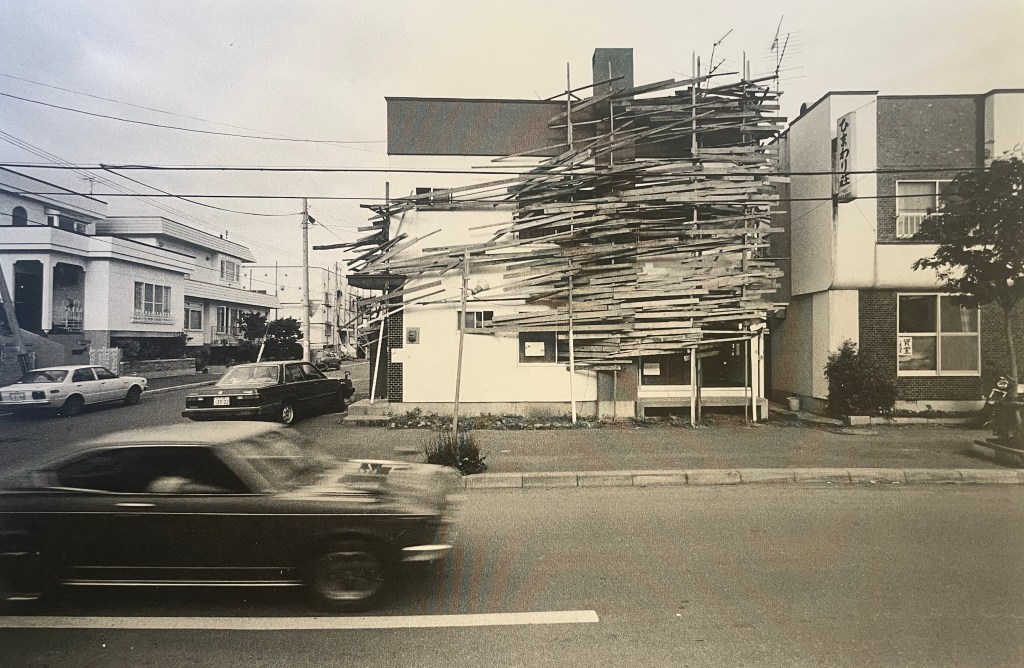
This work was created in the private home of Mr. and Mrs Endoh which was rented for one month. After a month of production and installation, the materials—borrowed from a construction company and local residents—were dismantled and returned to their owners. The project’s organizing committee consisted entirely of ordinary citizens. For the duration of the project, a series of related exhibitions took place throughout the local community, which can be regarded as an integral part of the installation itself.
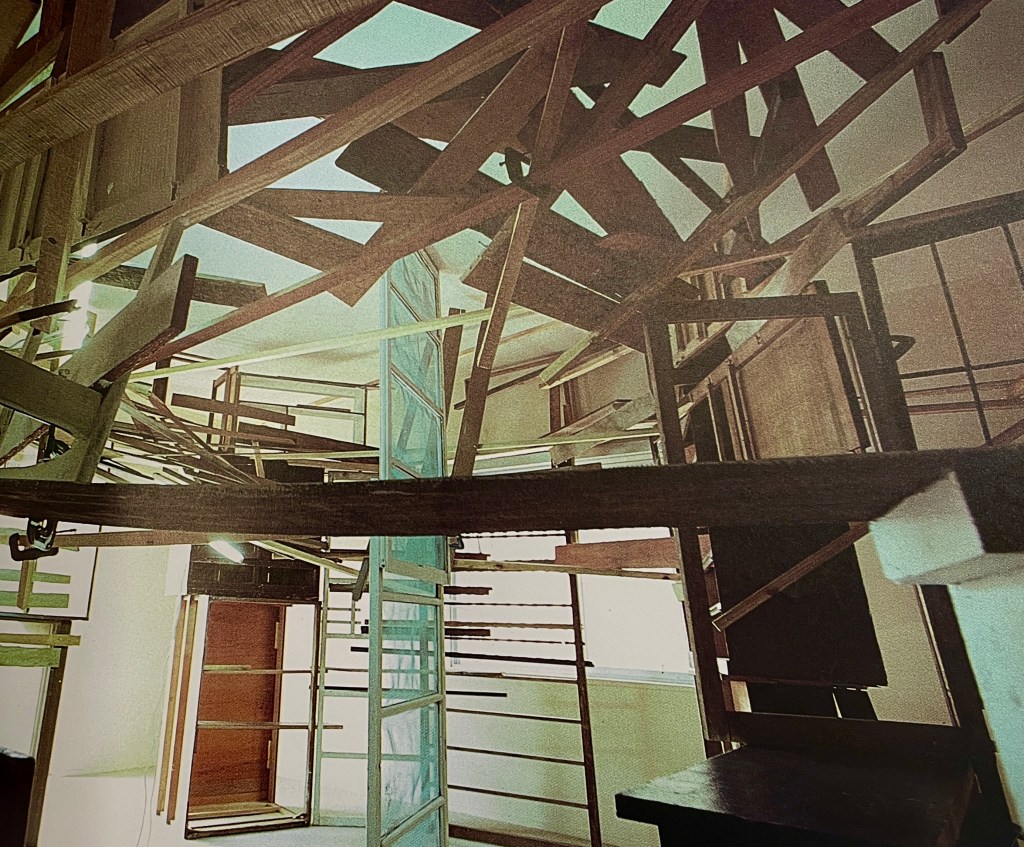
Revolution of Living Spaces
1984
Tokyo, Japan.
Organised in collaboration with PH Studio and produced by BRUTUS Magazine
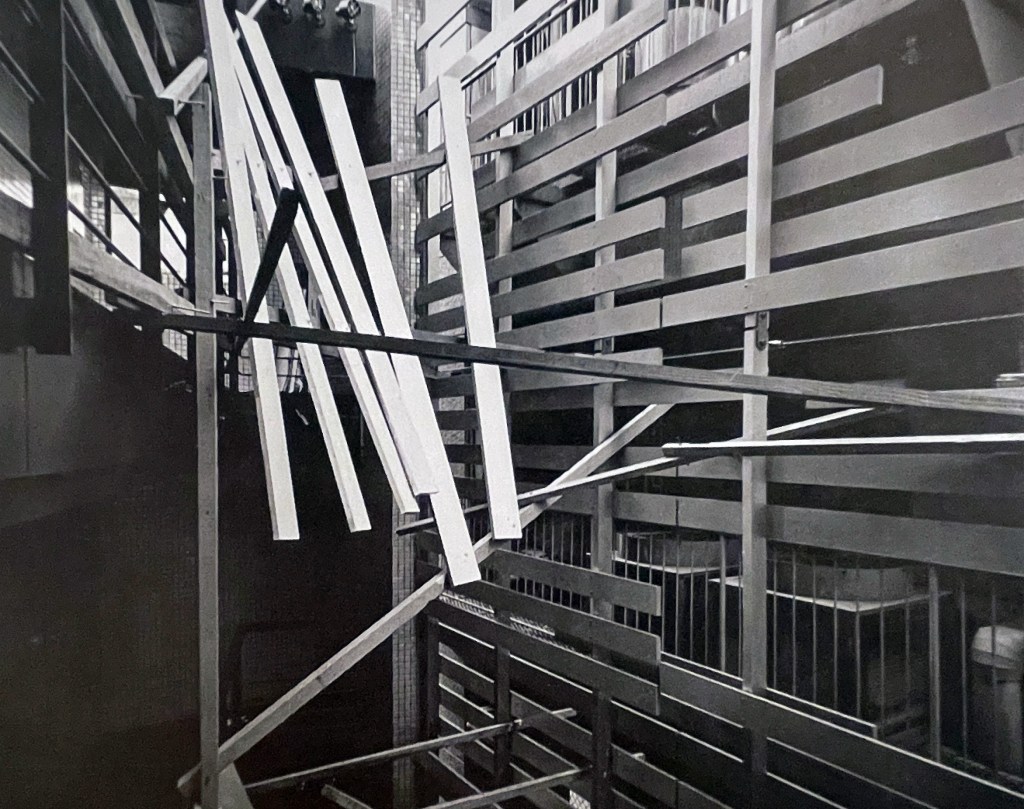
Glass Art Akasaka
1984
Kowa Building, Akasaka, Tokyo, Japan.
Organised in collaboration with PH Studio
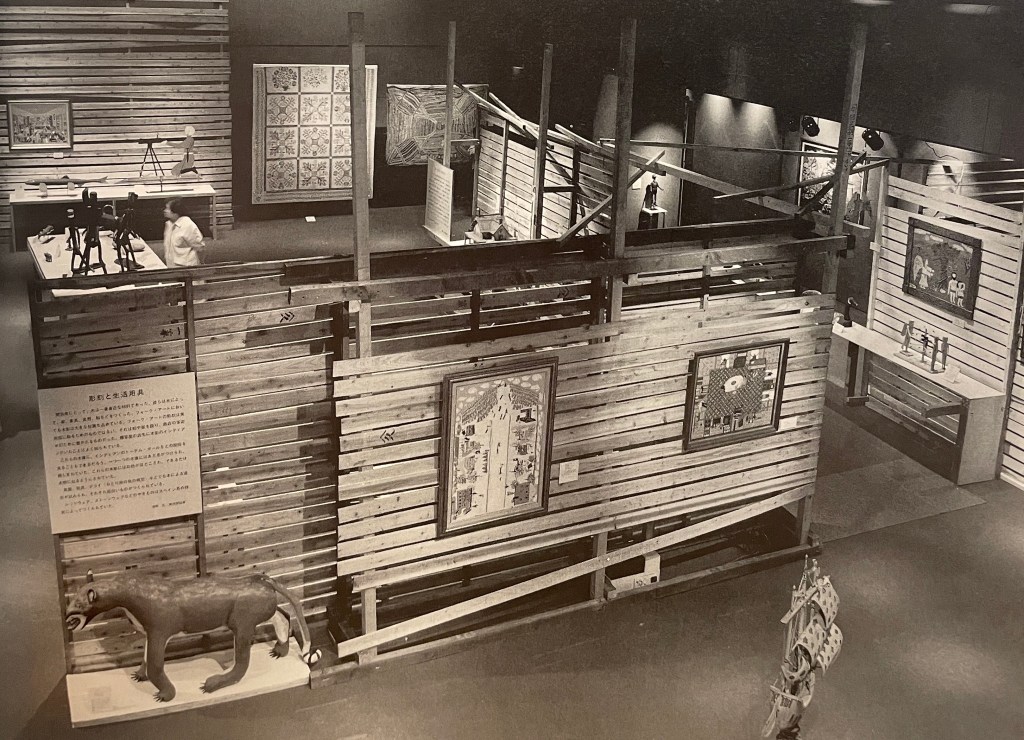
Composition of the Hall for the “American Folk Art Show”
1984
Laforet Museum, Tokyo, Japan.
Organised in collaboration with PH Studio
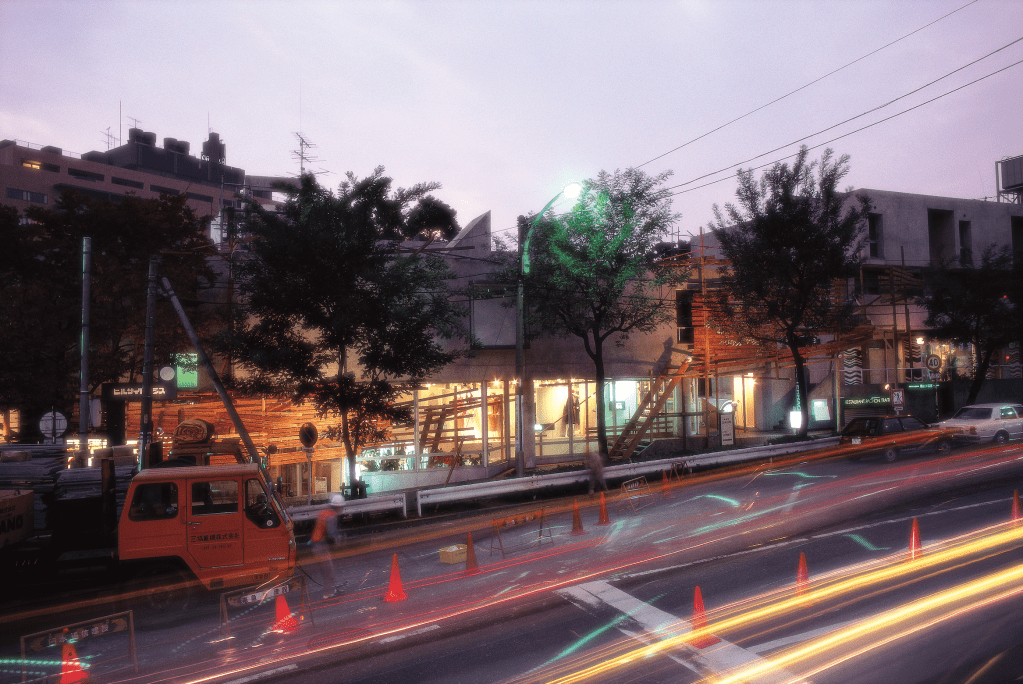
Under Construction
1984
Hillside Terrace, Daikan-yama, Tokyo, Japan.
For this large-scale installation, Kawamata used lumber to intervene on the building at Hillside Terrace – a multipurpose housing project in Daikanyamain, taking advantage of its ongoing renovation. The project commenced with the building manager’s permission, but it was never completed and was dismantled after only one week due to objections from nearby shops. Organized by PH Studio and Art Front Gallery – this work was intended to expand throughout the entire complex and to integrate a temporary installation into the everyday fabric of the city.
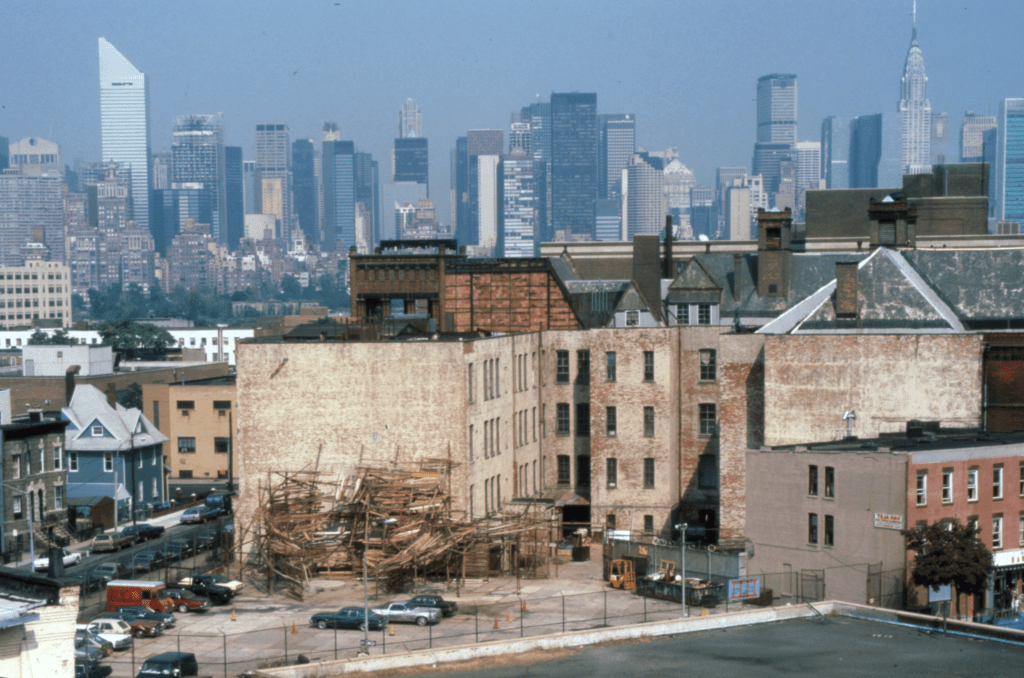
PS1 Project
1985
MoMA PS1, New York, US
Tadashi Kawamata first visited the PS1 Studio site in the autumn of 1982, followed by a series of subsequent meetings on location. In his initial plan, developed in the autumn of 1983, he intended to make use of the interior spaces of the room and hall; however, the project was later revised to include the courtyard. The work was supported by a grant from the Asian Cultural Council.
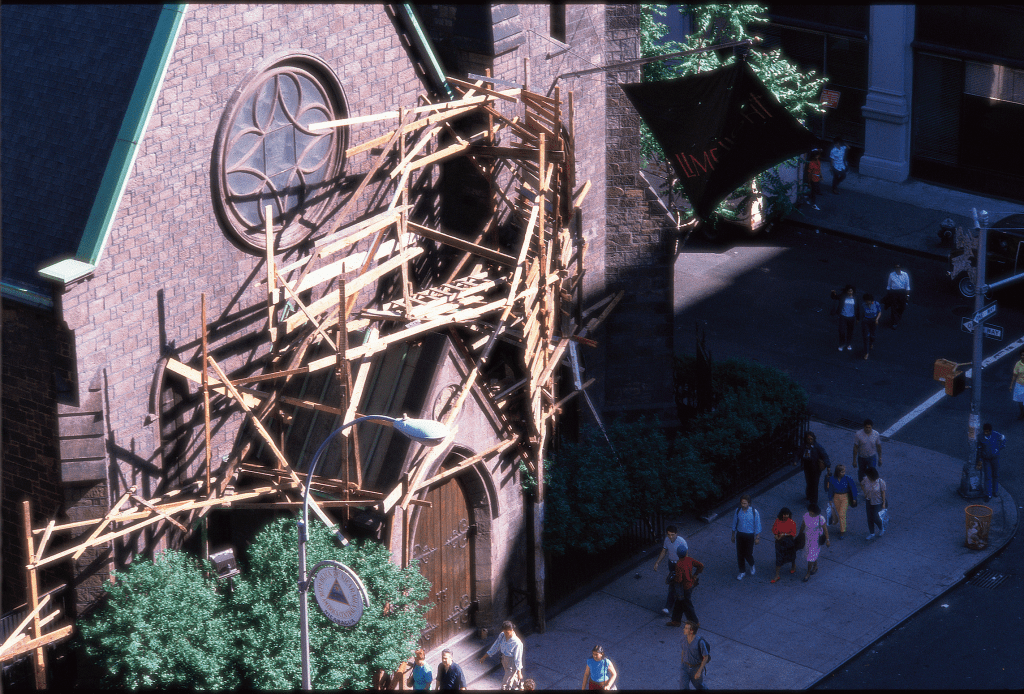
Limelight Project
1985
The Limelight, New York, US
While in residence at P.S.1’s International Studio Program between 1984 and 1985, Kawamata established connections that would lead to several significant projects in New York in the following years. During the Open Studio exhibition, Malcolm Kelso, art director of the Limelight, visited Kawamata’s studio and invited him to create a commissioned work after seeing photographs of his Tetra House project realized in Japan. The Limelight, a former church converted into a nightclub in 1982, retained much of its original architecture, creating a striking contrast between its historical structure and its new function. Kawamata was particularly intrigued by the visual and symbolic tension between the building’s sacred origins and its contemporary use. He proposed to envelop the church’s façade with a temporary wooden structure, emphasizing the dialogue between transformation and preservation. As the building was a designated New York City landmark, obtaining official permission proved challenging and was granted only at the last moment. Initiated in April 1985, the installation was suspended in mid-May by municipal order but remained on view for about a month before being dismantled.
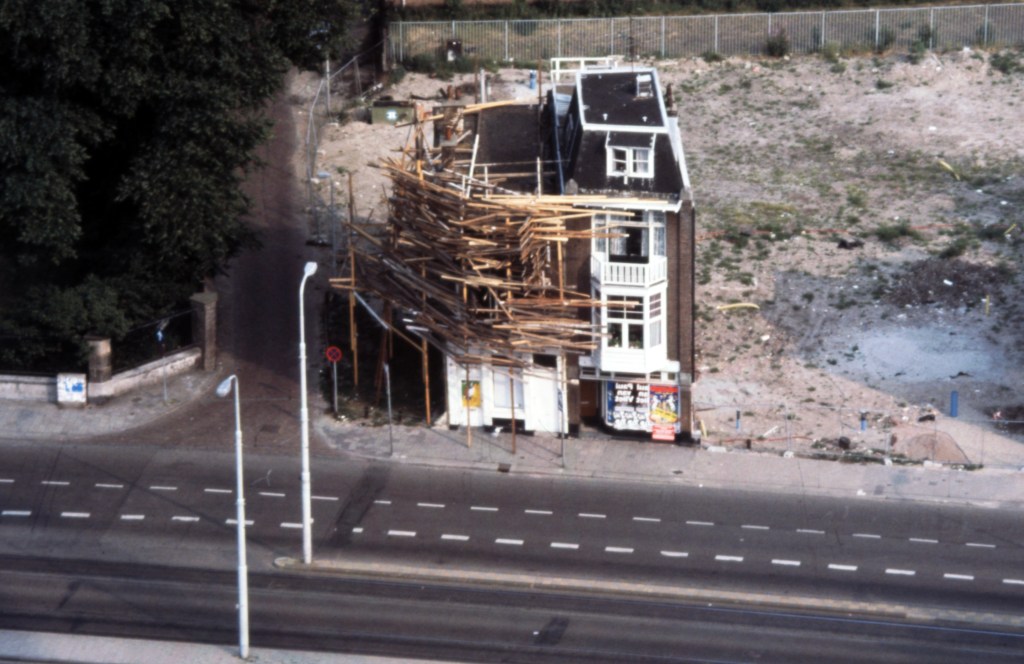
Spui
1986
Spui Straat, Den Haag, The Netherlands
Organized by The Hague’s Gemeentemuseum and The City of the Hague, this installation was created in a private family house on Spui Street that was facing demolition, situated within an area undergoing extensive renovation for the construction of new cultural facilities. Highlighting the temporal and fragile nature of architecture, Kawamata’s temporary installation drew attention to the processes of transformation that shape the city and alter our relationship with the built environment. The project invited reflection on the intersection of art and urban redevelopment, exploring how creative interventions can dynamically engage with, and temporarily inhabit spaces in transition.
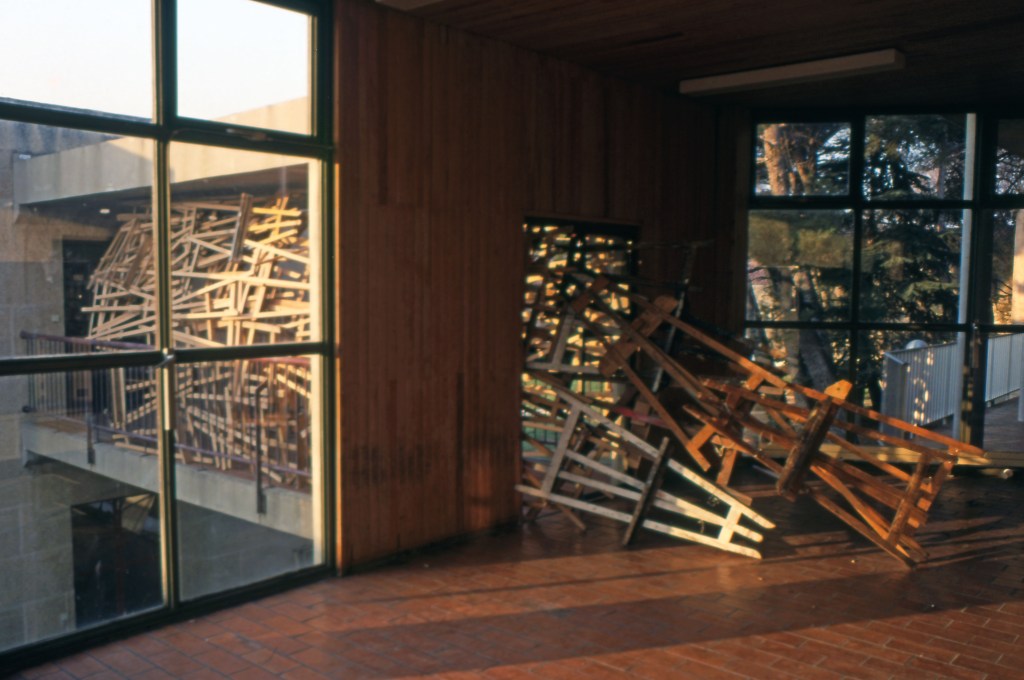
Installation at Aix en-Provence
1987
Ecole des Beaux-Arts d’Aix en-Provence, Aix en-Provence, France
On the occasion of Japon Art Vivant ‘87
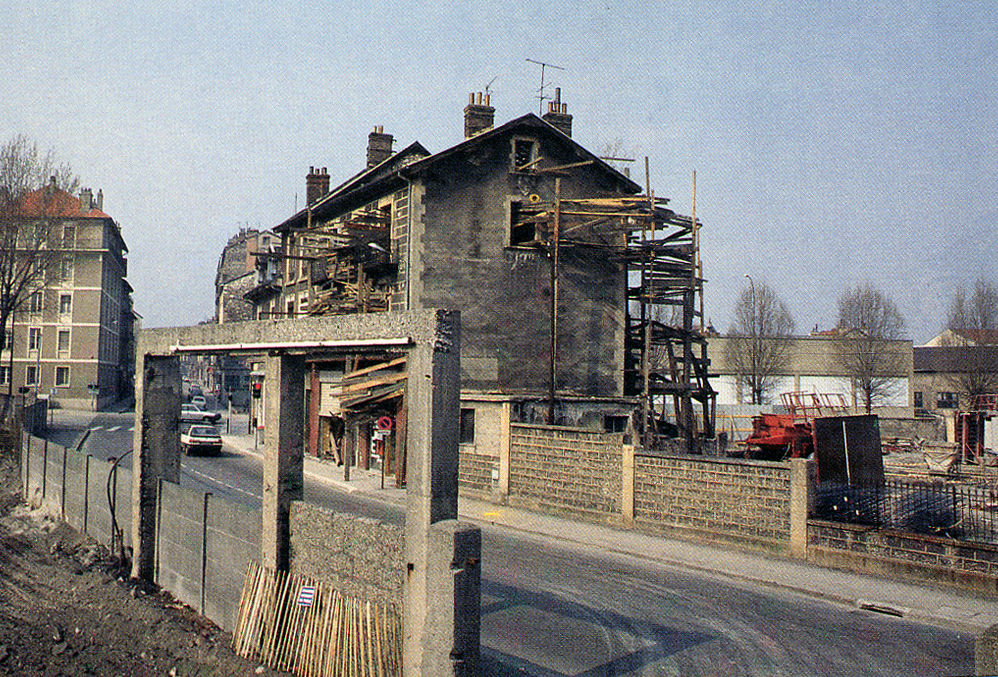
La Maison des Squatters
1987
Grenoble, France
In collaboration with the École des Beaux-Arts de Grenoblen on the occasion of Japon Art Vivant ‘87
Within the context of the Japon Art Vivant ’87 event, Tadashi Kawamata created La Maison des Squatters, a temporary intervention on an abandoned building slated for demolition. Using reclaimed materials and collaborating with students from the École des Beaux-Arts de Grenoble, Kawamata constructed a structure that enveloped and filled the building. The project reflects the artist’s interest in the role of art as a catalyst for transforming urban spaces and fostering collective participation.
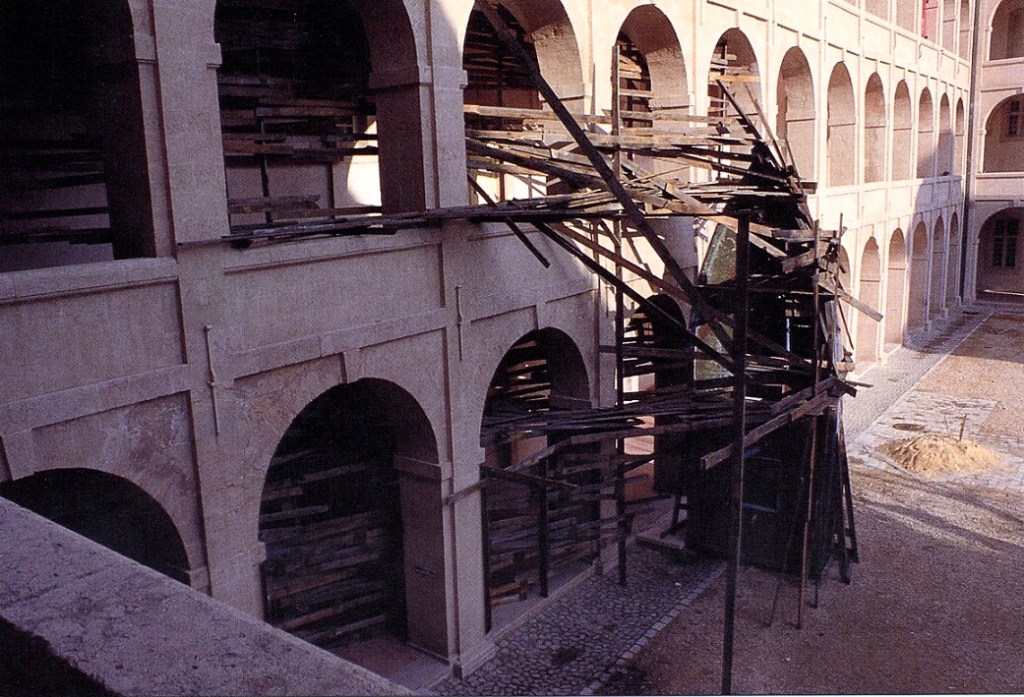
Project work in Vieille Charité
24 January – 8 March 1987
Centre de la Vieille Charité, Marseille, France
In the context of the exhibition Japon Passé Présent – Japon Art Vivant ‘87
This iconic site-specific work marked Kawamata’s first project in Canada. Invited by Mercer Union, he created a temporary outdoor installation that reshaped Toronto’s downtown landscape. From 7 September to 7 October 1989, the installation occupied Colonial Tavern Park on Yonge Street — a modest 50-by-105-foot lot directly across from the Eaton Centre. Once home to a renowned jazz club, the recently converted parkland was bordered by two neoclassical bank buildings: one evoking Renaissance domed palaces, the other recalling the temples of ancient Greece. Kawamata’s wooden structure, built from rough and reclaimed timber, seemed to hover between the scaffolding of a site under construction and the ruins following a demolition. It echoed the look of Toronto’s numerous building sites and reflected the endless cycle of construction and decay typical of urban environments. Monumental at first glance, the installation unfolded as an unexpectedly intimate experience, inviting visitors into a calm, contemplative space.
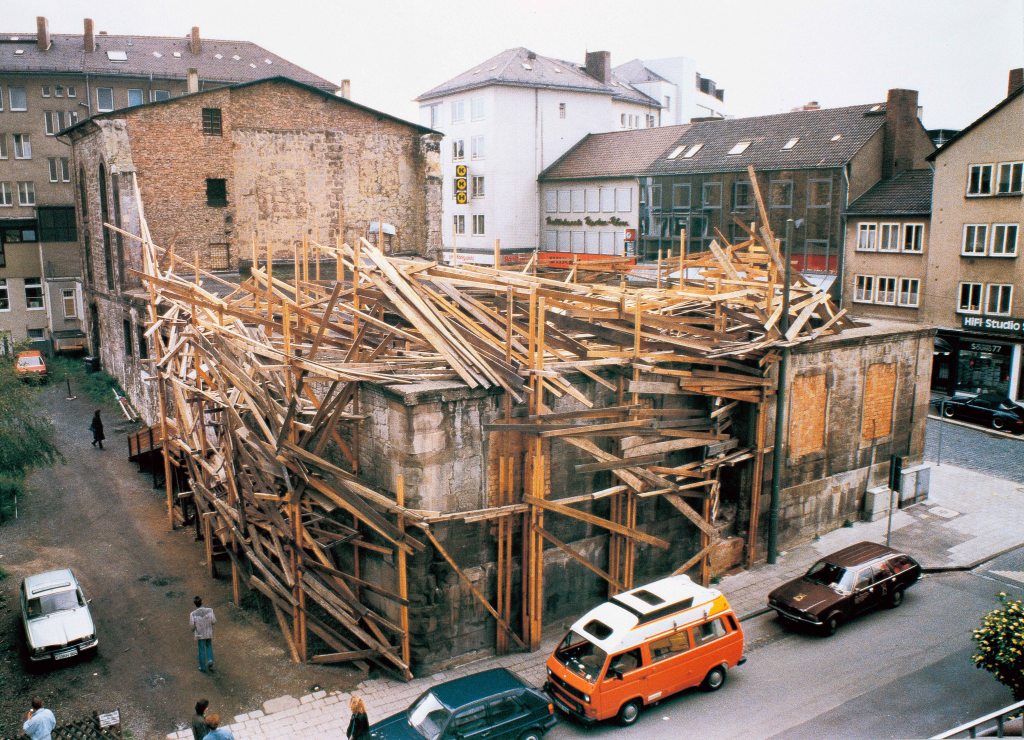
Destroyed Church
1987
documenta 8, Kassel, Germany
A site-specific installation on the ruins of the Garnisonkirche at Königsplatz in Kassel.
The city of Kassel suffered considerable damage during the Allied air raids in 1943. Garnisonkirche was almost completely destroyed, with only some external walls and its facade remaining. Over the years, soil accumulated on what used to be the church floor, and trees began emerging through the cracks in the mosaic tiles. Although the immediate vicinity of the church was rebuilt and modernized, the church itself remained in ruins for over 44 years – a visual reminder of the violent past that still haunts the city. Kawamata intervened on the site, working for about three months with the help of ten collaborators, constructing a temporary structure of reclaimed wood around the building that wrapped its ruins with long timbers, like a fence suspended in time and in the heart of the city. The construction process resembled an archaeological dig, as Kawamata and his team carefully engaged with the accumulated layers of history. Destroyed Church prompted reflection on the passage of time and highlighted the interaction between organic and historical time embodied in the site.
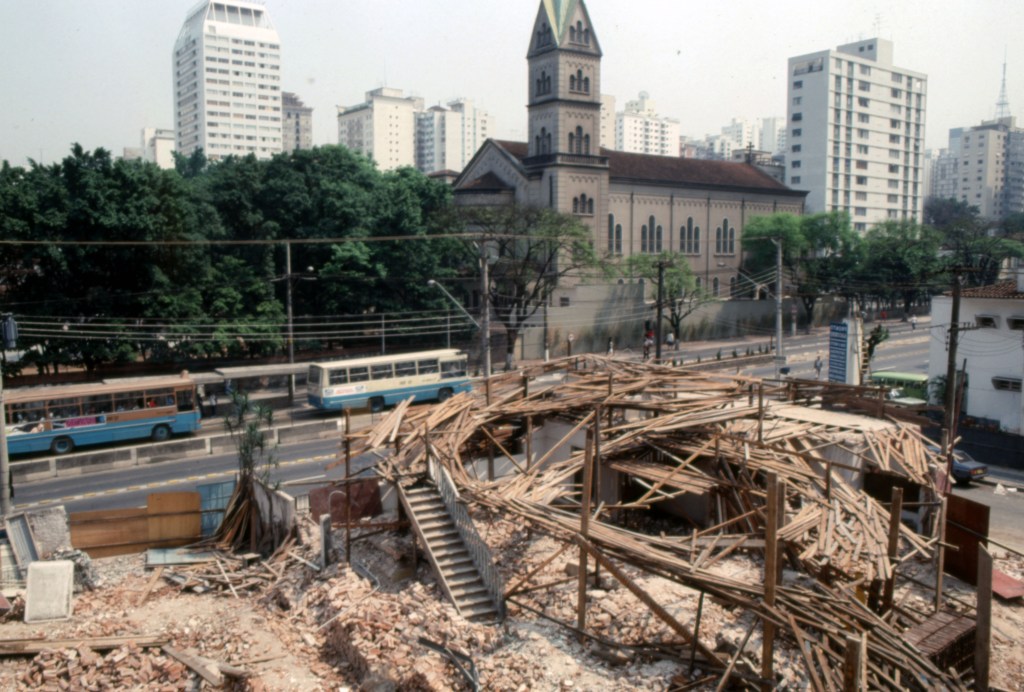
Nove de Julho Caçapava
1987
19th International Biennial of São Paulo, São Paulo, Brasil
A site-specific intervention on Nove de Julho Avenue, at the corner of Caçapava Street.
What I am doing is a kind of live art that captures the passing of time in the form of an ongoing operation.” TK
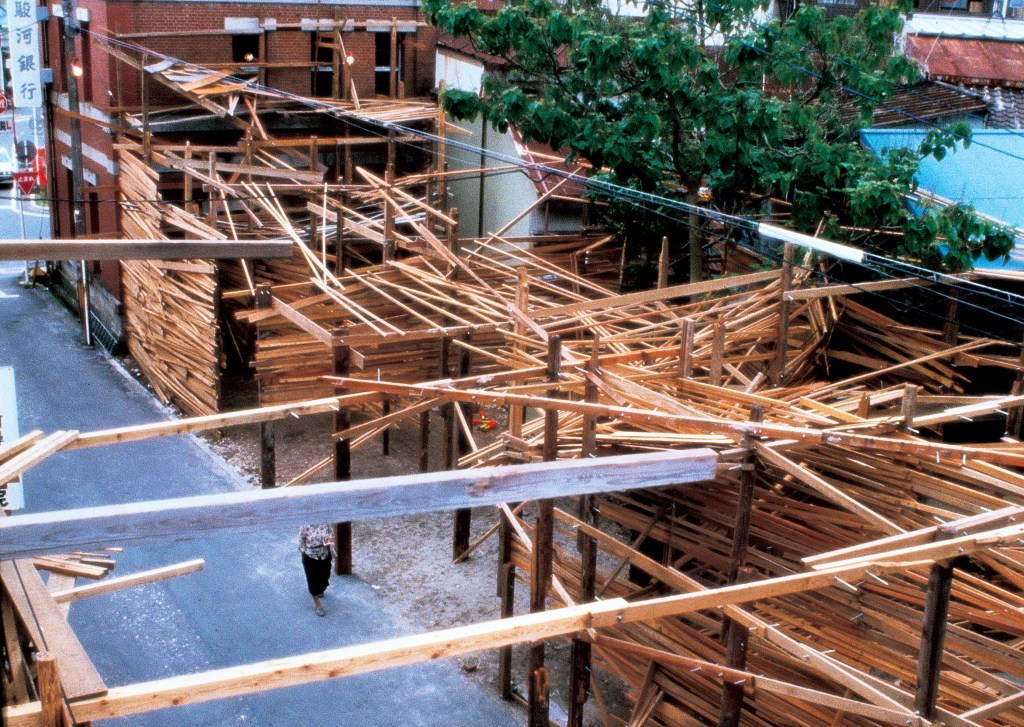
Fukuroi
1988
Aka-Renga Final, Suruga Bank, Fukuroi, Japan
I always work in joint projects. What is created doesn’t come just from one person’s consciousness but from an amalgamation of the consciousness of many people …. That is a lot more authentic than just working from my own narrow aesthetic”. TK
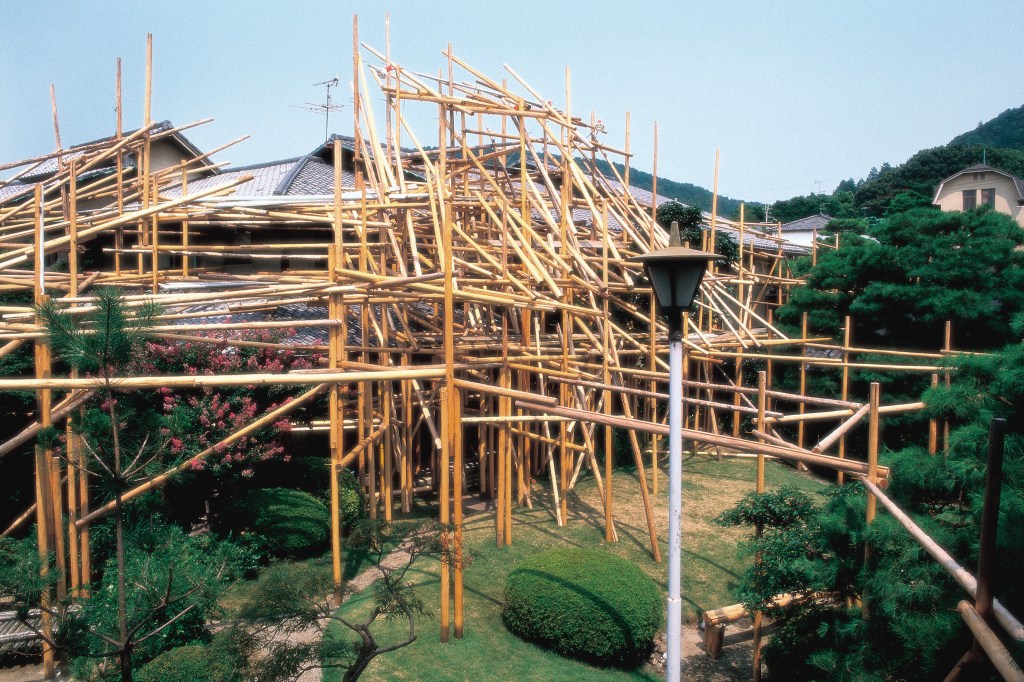
Hien-So
1988
Imakumano, Kyoto, Japan
Organized by Sagacyo Exhibit Space
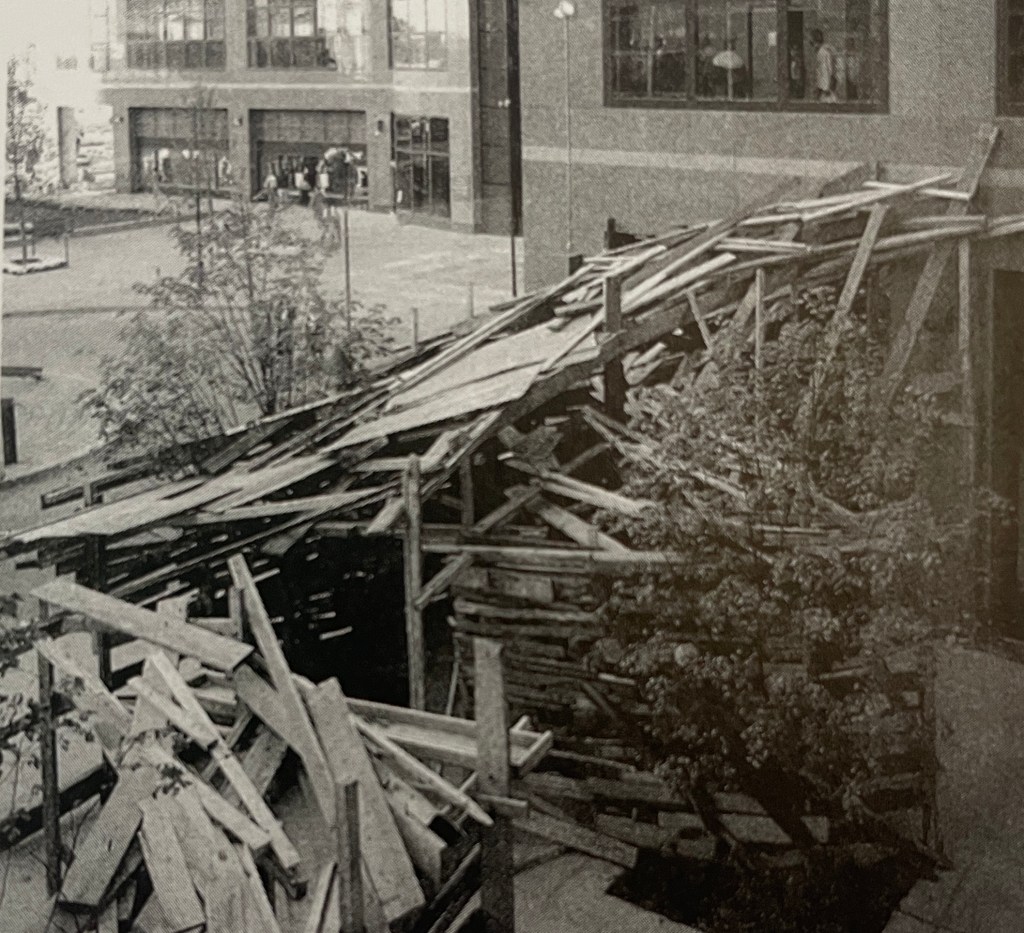
Favela in Battery Park
1988
World Financial Center, Battery Park City, New York, US
Invited to participate in the group exhibition The New Urban Landscape at the World Financial Center in New York City, Kawamata created an installation inspired by the favelas—the slum dwellings typical of South America. Characterized by the apparent randomness of its configuration, this assemblage of fragile, ramshackle structures extended from an exterior plaza into the lobby of the luxurious building, clashing sharply with its aesthetics and economic status. Availing himself of discarded lumber from a cluster of buildings under construction in the vicinity of New York’s Battery Park district, Kawamata built these precarious, hand-made shacks, whose vulnerable nature seemed to question the complicity of commercial developers in a social order that has produced widespread homelessness and an increasingly unsustainable and uncertain future for many.
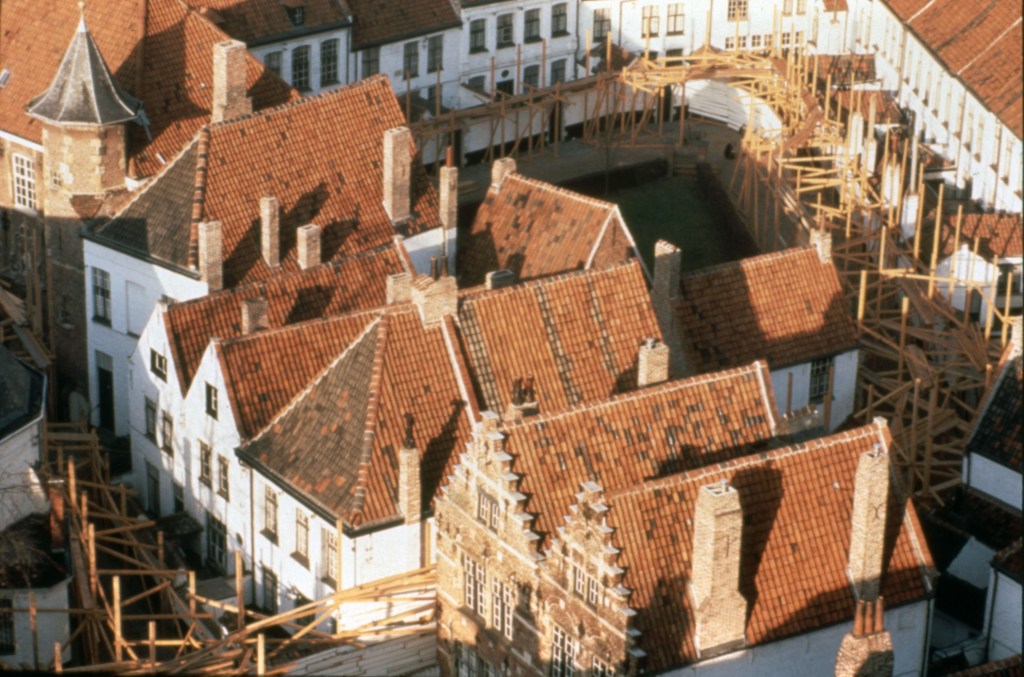
Begijnhof St-Elisabeth
23 October 1989 – 15 February 1990
Kortrijk, Belgium
Organised by Kanaal Art Fundation
In April 1988, the Kanaal Art Foundation invited Kawamata to create a site-specific installation in the historic center of Kortrijk. Despite challenges in obtaining permits, Kawamata selected the beguinage for its symbolic value as a “historic, peaceful, and spiritual oasis” within a busy commercial city. Respecting the life and architecture of the site, he conceived wooden structures that appeared as if they had always been part of the beguinage—resembling buttresses or scaffolding supporting and protecting the ancient walls. The intervention evoked the site’s continuous process of rebuilding and sought harmony with its architecture, streets, and residents, creating a dialogue between past and present. Over 143 cubic meters of wood were used to construct this scaffolding-like framework within the beguinage enclosure, without altering its original fabric. An accompanying exhibition of drawings, photographs, and video documentation was presented from 2 December 1989 to 7 January 1990 at the former primary school in the beguinage.
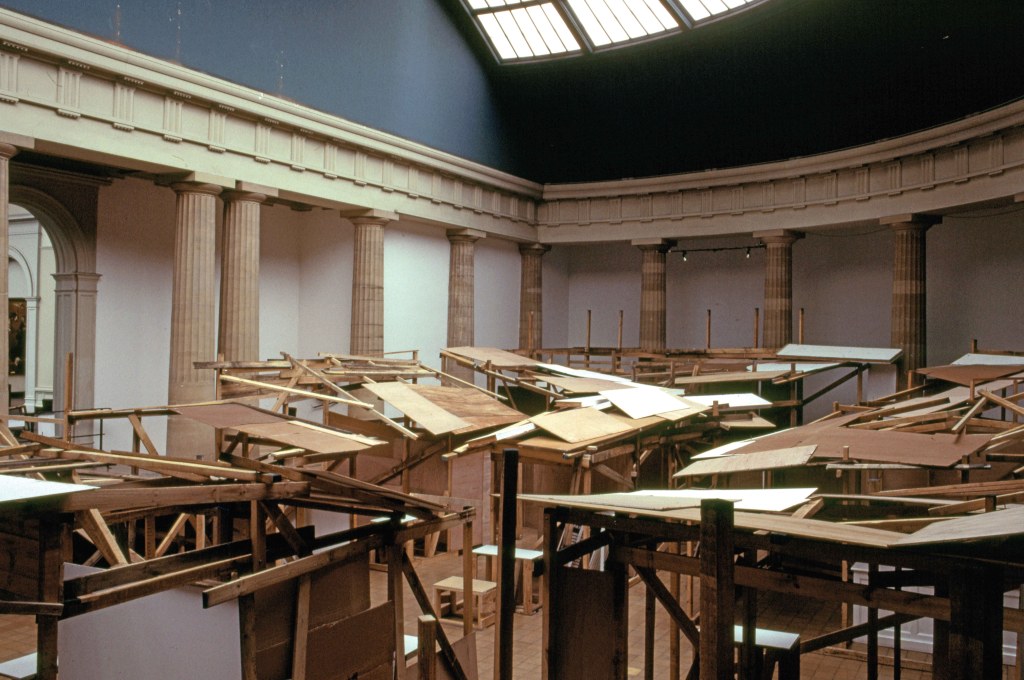
Bazaar
28 October 1989 – 7 January 1990
Museum van Hedendaagse Kunst Gent, Ghent
On the occasion of the group exhibition Japan ‘89
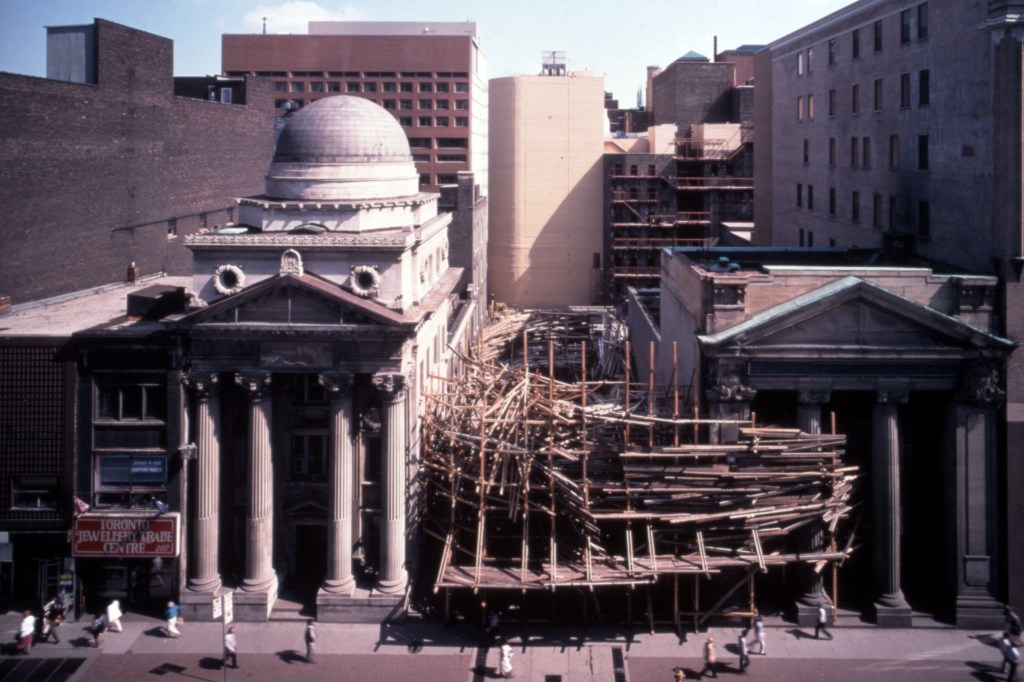
Toronto Project
7 September – 7 October 1989
Colonial Tavern Park, Toronto, Canada
In conjunction with the exhibition Tadashi Kawamata. Toronto project 1989 presented at the Mercer Union, Toronto
This iconic site-specific work marked Kawamata’s first project in Canada. Invited by Mercer Union, he created a temporary outdoor installation that reshaped Toronto’s downtown landscape. From 7 September to 7 October 1989, the installation occupied Colonial Tavern Park on Yonge Street — a modest 50-by-105-foot lot directly across from the Eaton Centre. Once home to a renowned jazz club, the recently converted parkland was bordered by two neoclassical bank buildings: one evoking Renaissance domed palaces, the other recalling the temples of ancient Greece. Kawamata’s wooden structure, built from rough and reclaimed timber, seemed to hover between the scaffolding of a site under construction and the ruins following a demolition. It echoed the look of Toronto’s numerous building sites and reflected the endless cycle of construction and decay typical of urban environments. Monumental at first glance, the installation unfolded as an unexpectedly intimate experience, inviting visitors into a calm, contemplative space.
