Select site-specific projects
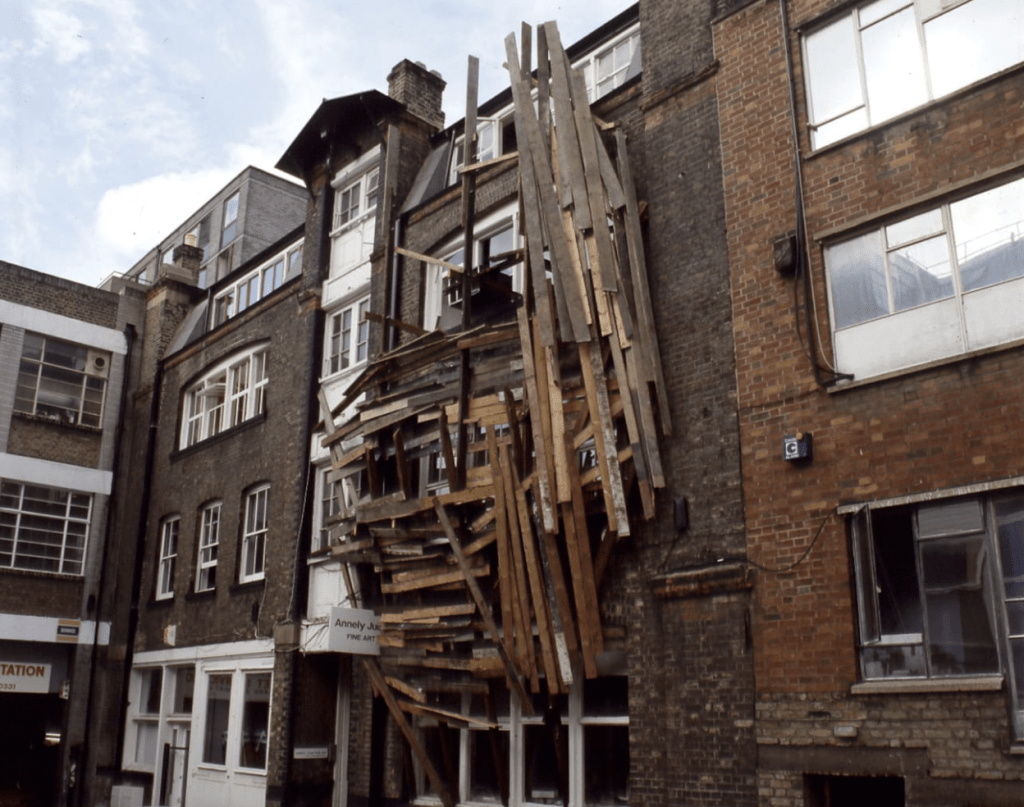
Project at Tottenham Mews
3 – 13 May 1990
Annely Juda Fine Art, Tottenham Mews, London, UK.
This project – a site-specific installation that unfolds between the building’s interior and exterior – marked the start of the artist’s ongoing relationship with the gallery
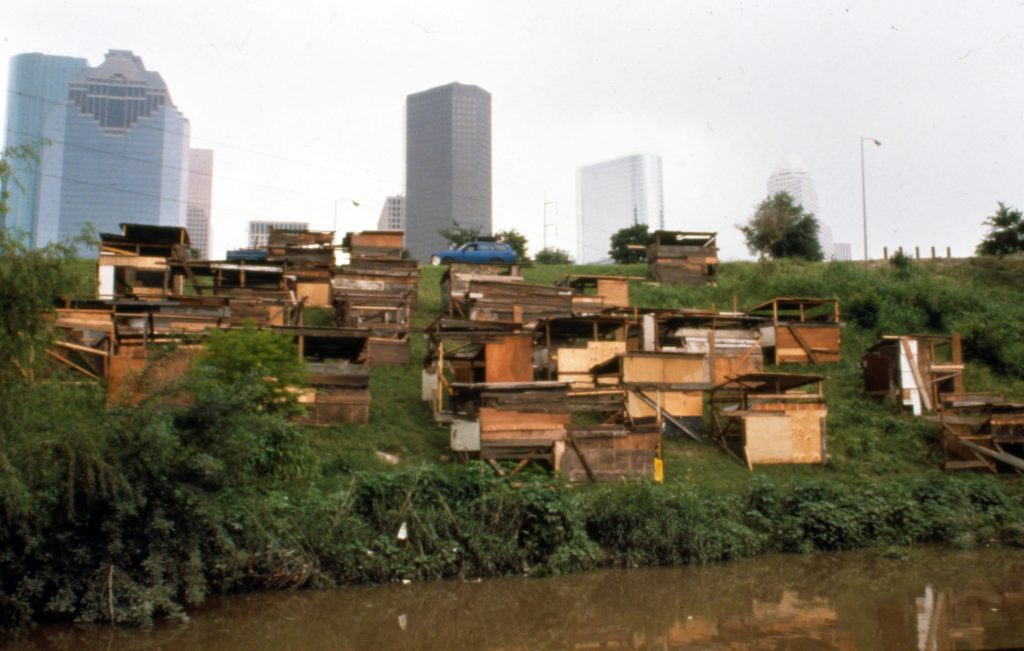
Favela in Houston
1991
Buffalo Bayou Riverside, Houston, USA.
On the occasion of the group exhibition Landscape: site-specific outdoor sculpture organised by DiverseWorks and the Houston International Festival, Tadashi Kawamata presented the installation Favela, a cluster of small huts made from wood, sheet metal, and recycled materials, tightly packed together on a vacant lot along the riverside. These precarious structures, built from discarded timber sourced from nearby residential areas, stood in dramatic contrast to the city’s towering high-rises in the background, echoing the adjacent urban development zone. The work raises questions about the fragility of housing and the social challenges of contemporary urban life
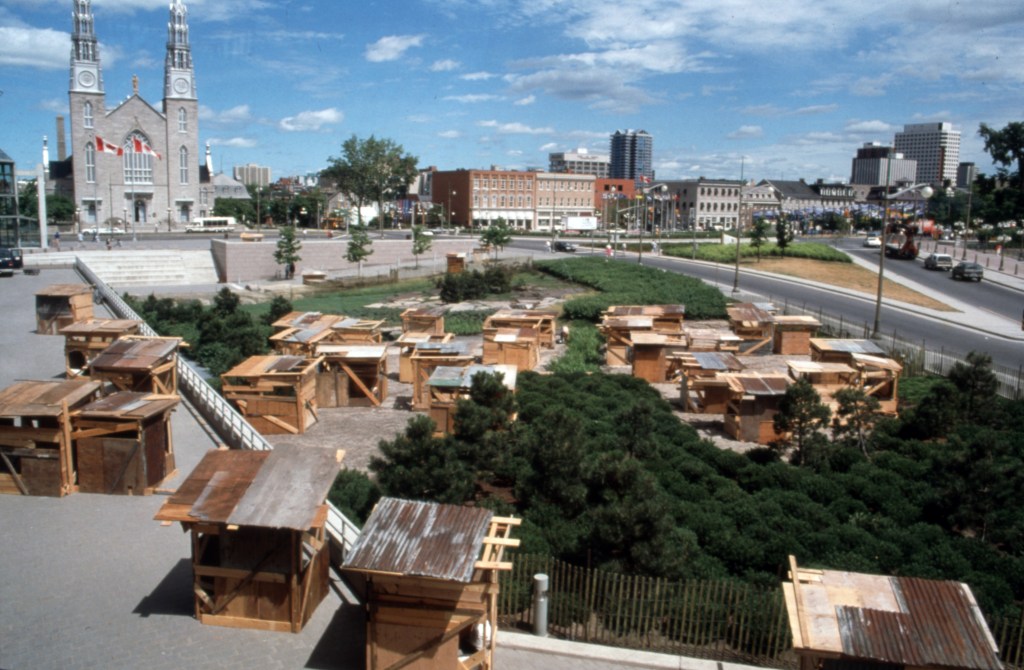
Favela in Ottawa
1991
National Gallery of Canada, Ottawa, Canada.
In the context of the touring group exhibition A Primal Spirit: Ten Contemporary Japanese Sculptors. Travelled to Canada: 28 June — 22 September 1991
As part of the exhibition A Primal Spirit: Ten Contemporary Japanese Sculptors, Kawamata presented an outdoor, site-specific installation titled Favela in Ottawa, consisting of 35 wooden huts erected in the Taiga Garden beside the National Gallery of Canada.
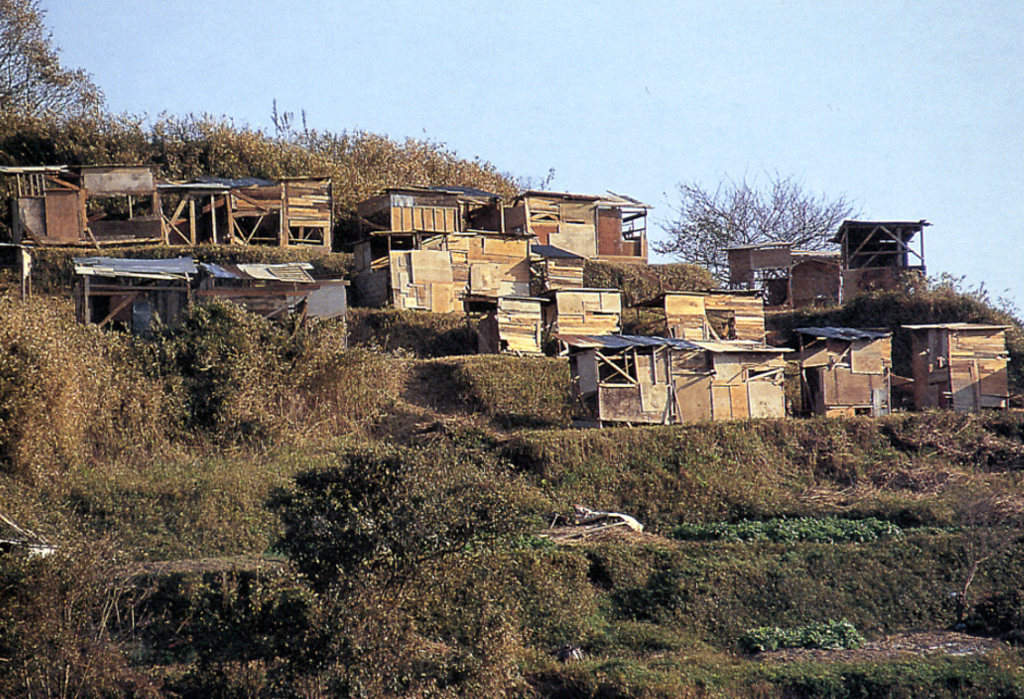
Favela in Ushimado
2-4 November 1991
Ushimado, Japan.
On the occasion of the 4th Japan Ushimado International Biennale themed Seeking Invisible Space. Participating artists: Anish Kapoor, Gottfried Bechtold, Nomura Hitoshi, Tadashi Kawamata.
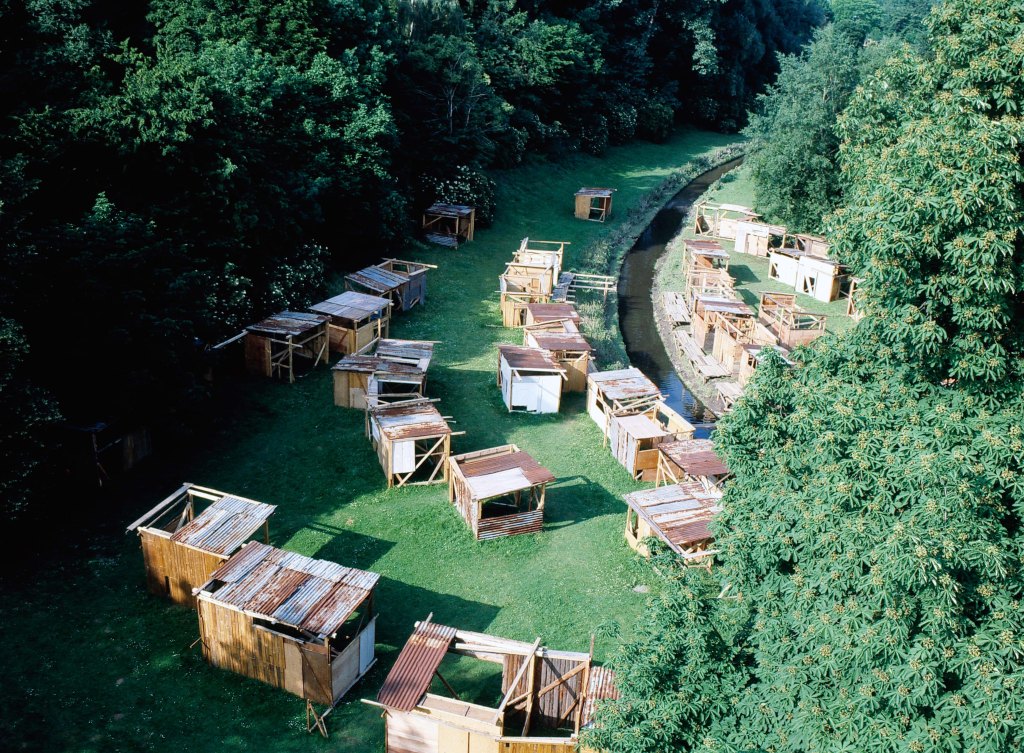
For his participation in Documenta IX, Kawamata presented a temporary installation that extended along both banks of the Drusel River, also known as the Kleine Fulda. Revisiting the Favela theme that he had begun exploring the previous year with three projects (Houston, Ottawa, and Ushimado), the artist created a cluster of wooden, shack-like structures that engaged viewers with ideas of home, shelter, and social context. The project takes its name from a small garden within the settlement, where vegetable plots are interspersed with sheds for working tools.
Project on Roosevelt Island
1992
Small Pox Hospital, Roosevelt Island, New York, US.
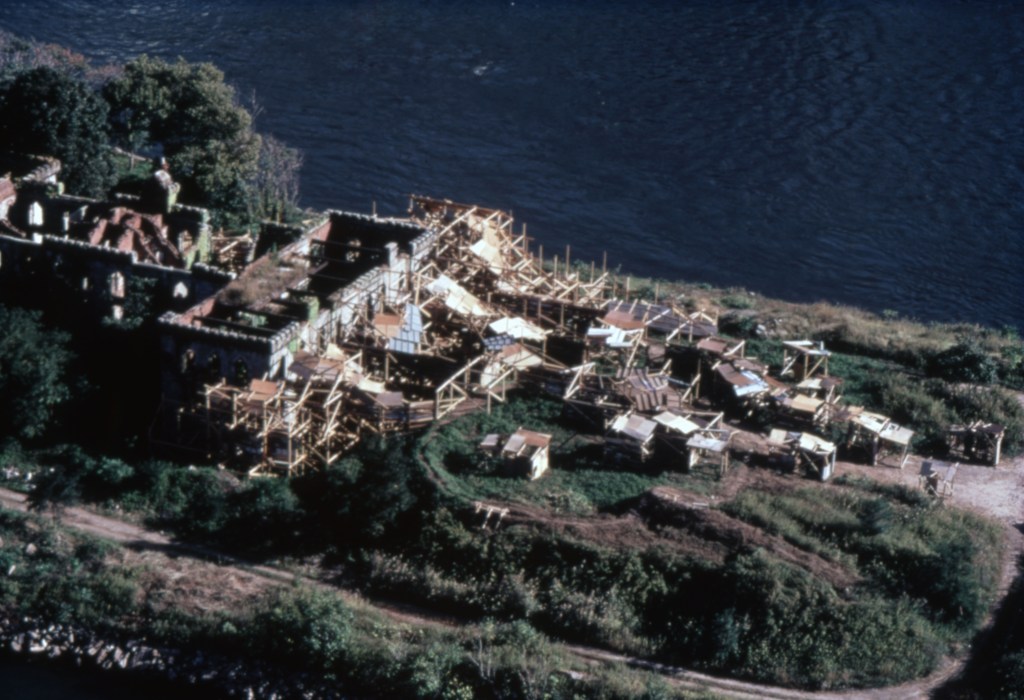
Tadashi Kawamata’s monumental site-specific installation Project on Roosevelt Island enveloped and transformed the ruins of the Smallpox Hospital, situated on an island facing Manhattan in the middle of New York City’s East River. This 19th-century hospital was originally designed by James Renwick, Jr., the architect of St. Patrick’s Cathedral in New York and the Smithsonian “Castle” in Washington, D.C. Over the course of five months, Kawamata constructed a structure composed of thousands of wooden planks, scrap wood, and salvaged materials collected from Manhattan and Queens. His intervention extended the ruins with an external wooden armature that neither altered nor touched the original structure. On the horizon, across the river, rises Manhattan with its skyline of high-rise buildings and dense urbanization. This contrast further emphasizes the abandonment of the island, which appears as a forgotten place. By presenting a space of ruin, Kawamata’s project becomes an exploration of material and social transformation in urban life, evoking abandoned or disused spaces that quietly disappear or sink into oblivion.
“About a hundred years ago, Roosevelt Island was home to an isolation ward for smallpox, and the island itself has its own historical significance. In a way, these relations could only be revealed to a broader public through art. Indeed, what was interesting to see was how the project changed locals’ perceptions of the site.” TK
Passaggio
1993
Prato, Italy
Organised by Centro per I’Arte Contemporanea Luigi Pecci, as part of the exhibition Inside Out. Museo Città Eventi, taking place from 27 March to 16 May 1993.
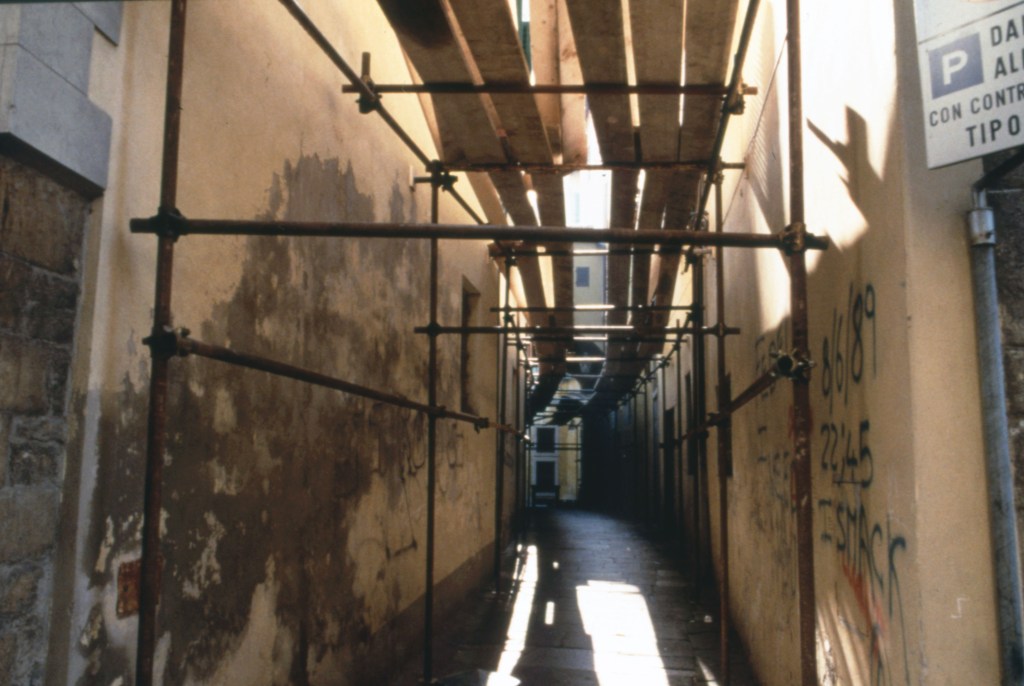
The show Inside Out organised by Centro per I’Arte Contemporanea Luigi Pecci and curated by Director Ida Panicelli was composed of three sections: “Museo” (Museum), including works by Karen Knorr and Giulio Paolini; “Città” (City), consisted of installations by Barbara Kruger and by Tadashi Kawamata; and “Eventi” (Events), was comprised of a concert and four performances. Kawamata intervention Passaggio consisted of wood scaffolding installed in the small streets of the city center of Prato.
Frauenbad
1993
Limmat River, Zurich, Switzerland.
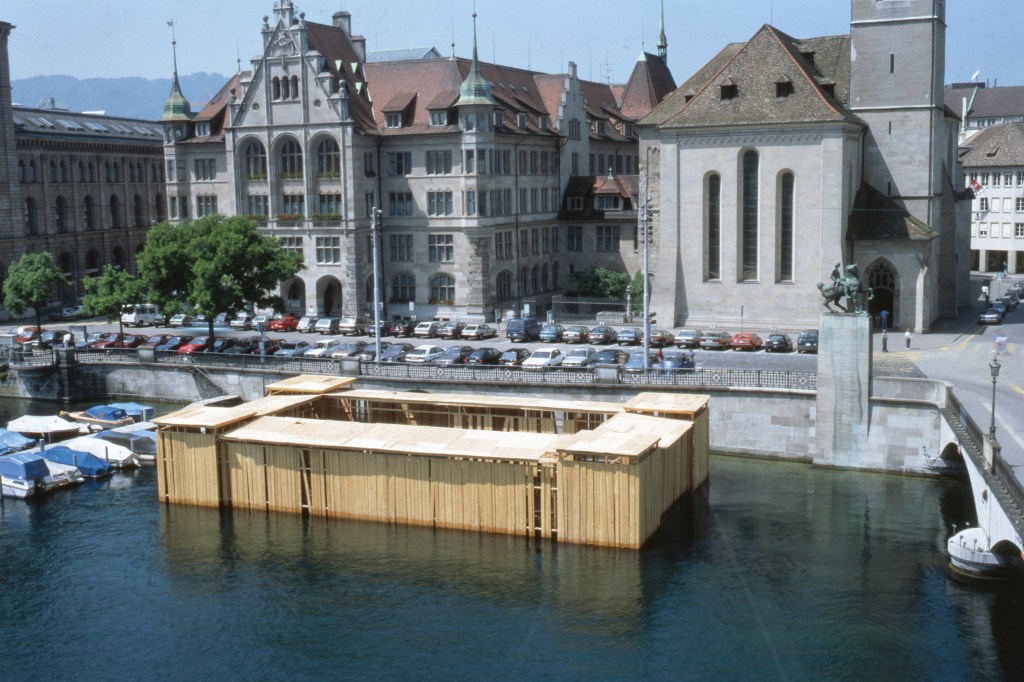
In 1993, Tadashi Kawamata realized Frauenbad, a site-specific installation on the Limmat River in Zurich, Switzerland. Organized by the Helmhaus Zürich, the project took place at the historic Frauenbad, a women’s bathhouse located in the heart of the city. This symbolic landmark of Zurich embodies both the city’s social history and architectural heritage, merging tradition with contemporary cultural life. Built in 1888 in the Art Nouveau style on wooden pontoons anchored to the river, the bathhouse offers spaces for swimming, with changing cabins, wooden decks, and areas for relaxation. Kawamata’s intervention expanded the historic wooden structure on the Limmat without altering its original fabric, creating a dialogue between art, social history, and architectural heritage.
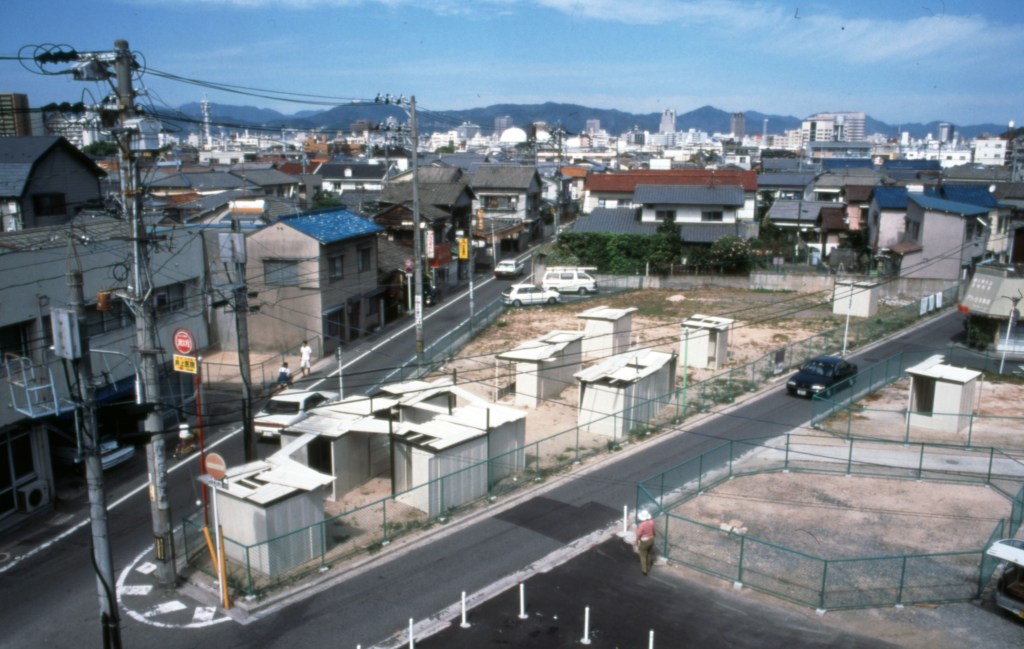
Prefabrication Hiroshima
1994
Hiroshima, Japan
Part of the group exhibition Creativity in Asian Art Now organised by the Hiroshima City Museum of Contemporary Art.
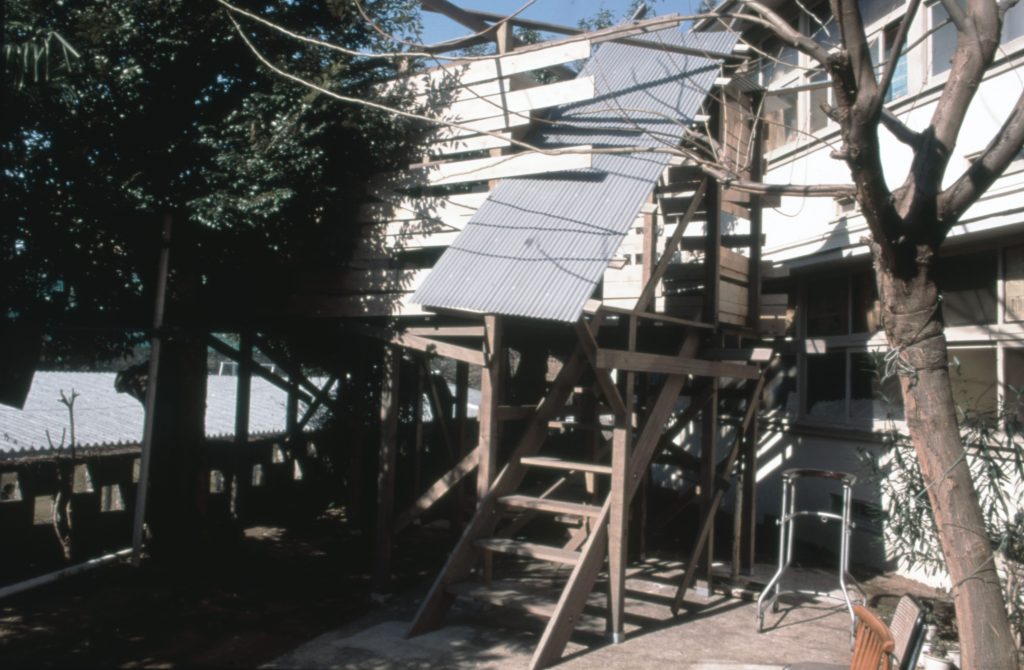
Sanatorium
1994
Senzokuike Hospital, Tokyo, Japan
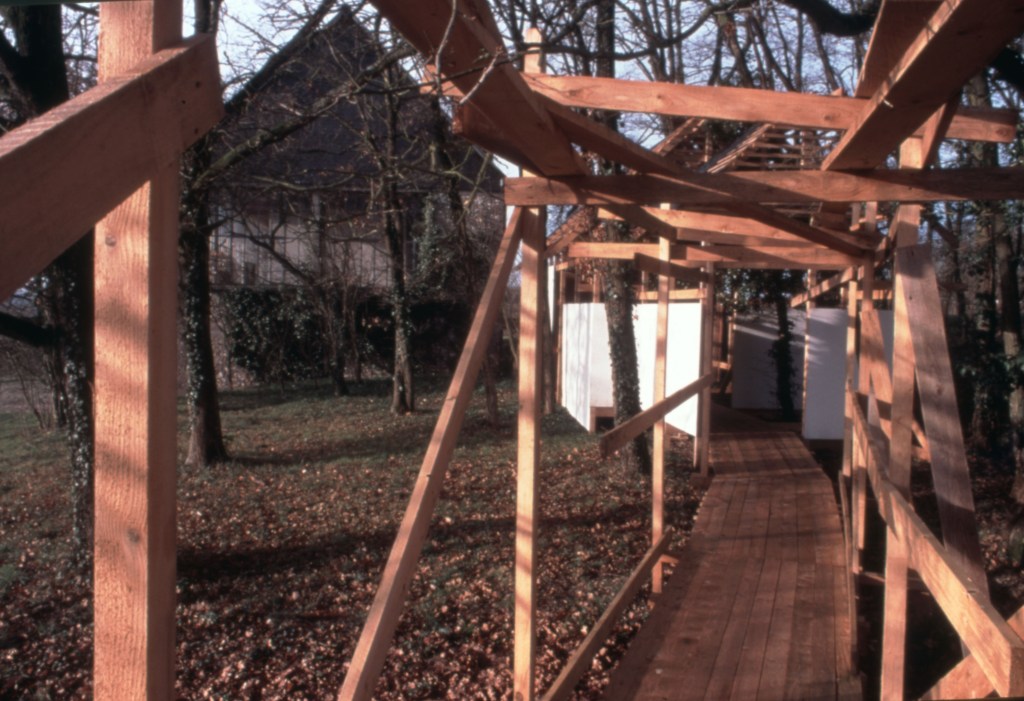
Transfert
1994
CCC – Centre de Création Contemporaine, Tours and Atelier Calder, Saché, France
At the conclusion of his six-month residency at Atelier Calder in 1993, Kawamata presented a multi-part exhibition comprising three interconnected stages: a display of works at the CCC gallery, an installation within the Atelier Calder and his residence, and an intervention linking the three sites. The work encompassed both the areas in which visitors moved and the artworks themselves, incorporating transitional spaces as active elements of the project. At the CCC, he constructed an imposing structure that subverted the space, inviting visitors to navigate around it and explore storage areas where crates used for transporting artworks were kept, some revealing projects he had produced in France in previous years. A bus transported visitors from the CCC to the Atelier, passing through a series of wooden shelters, while a footbridge of interwoven planks connected the studio to the apartment, guiding visitors to the residency site. By integrating his studio and apartment with the exhibition space, he sought to create a new paradigm – one that was neither a conventional gallery nor a private studio.
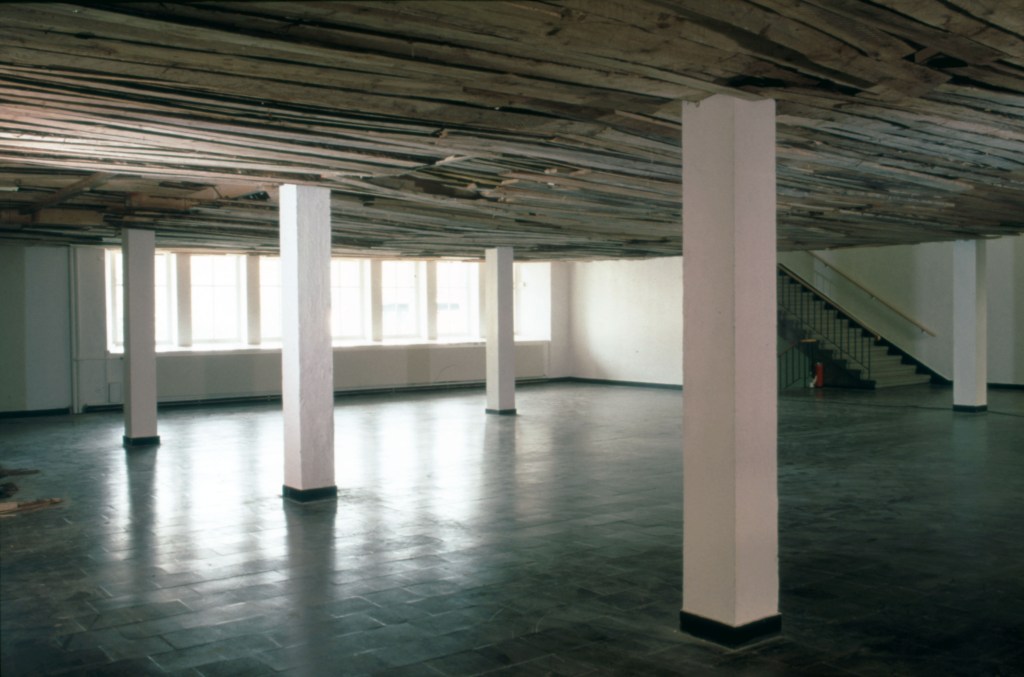
Bunker
7 May – 2 July 1995
Kunsthalle Recklinghausen Recklinghausen, Germany
From 7 May to 20 August 1995, the site-specific installation Bunker was presented at the Kunsthalle Recklinghausen as part of the exhibition Kawamata: Kunstausstellung Der Ruhrfestspiele Recklinghausen 1995, celebrating the Ruhrfestspiele, an important annual theatre and cultural festival. Engaging with the historical function of the Kunsthalle as a bunker during the Second World War and referencing the distinctive character of the Ruhr region as a coal-mining area, Kawamata created a monumental, tunnel-like wooden structure spanning the building’s three floors, constructed from modest and recycled materials associated with collieries. The scent of the wood enhances the sensory experience, while the installation transforms the spatial and visual environment and actively engages visitors with the material and physical qualities of the space.
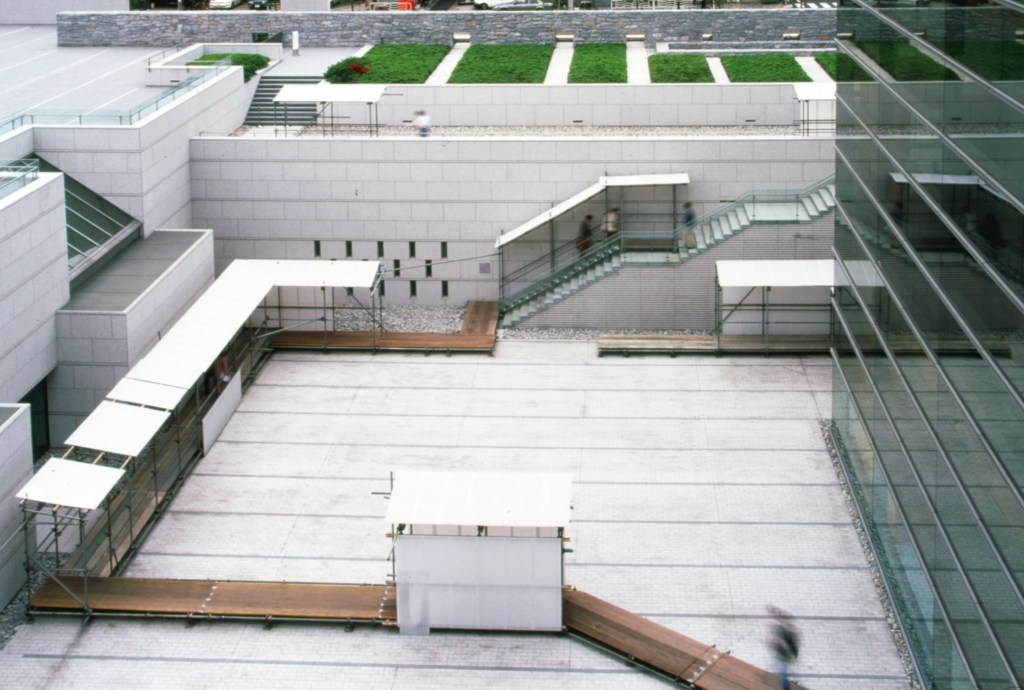
Catwalk
19 March – 21 May 1995
Museum of Contemporary Art Tokyo, Tokyo, Japan
Part of the group exhibition Art in Japan Today: 1985-1995
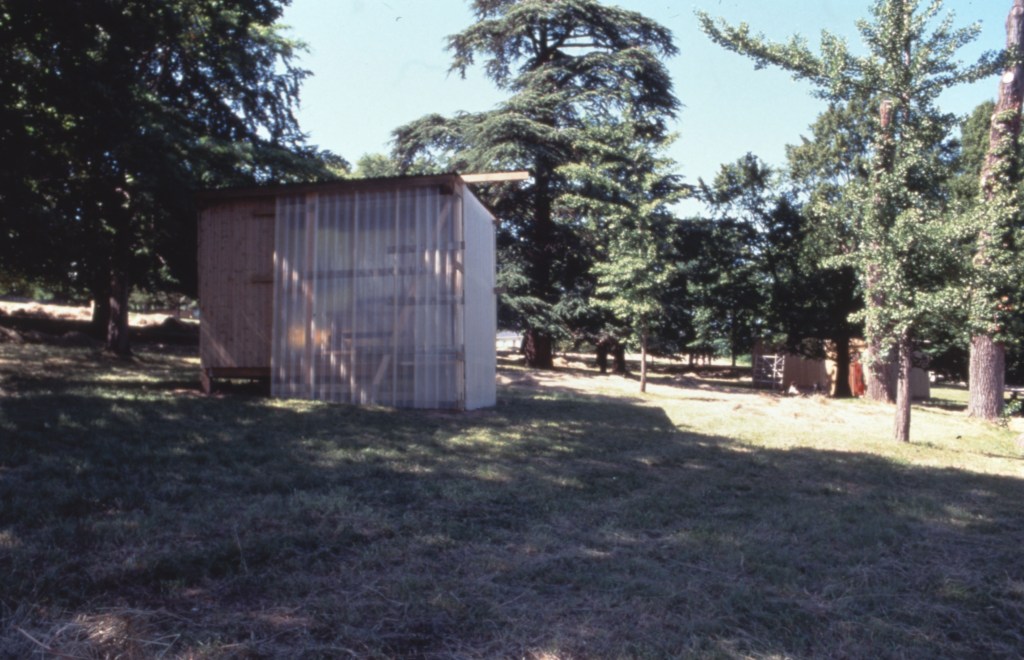
Cabanons
3 July – 24 October 1995
United Nations Office building, courtyard, and Ariana Park, Geneva, Switzerland
Part of the group exhibition Dialogues of Peace.
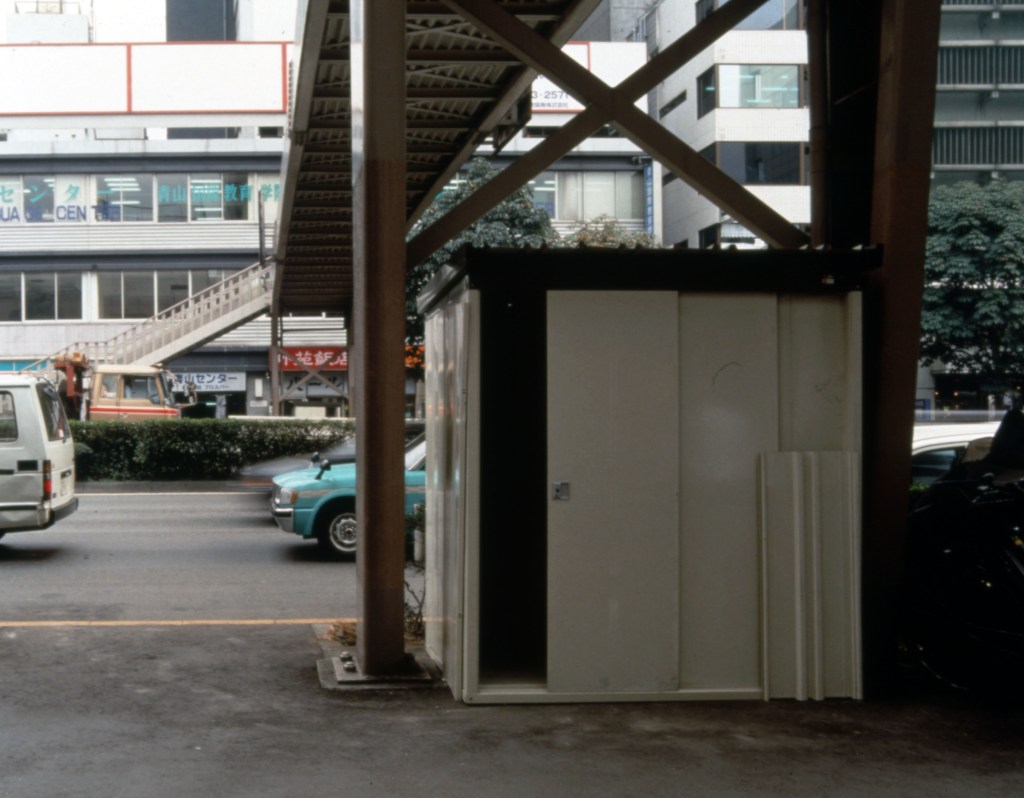
Prefabrication Tokyo/Kobe
2 September – 1 October 1995
Watari Museum of Contemporary Art, Tokyo, Japan.
Part of the group exhibition Ripple Across the Water
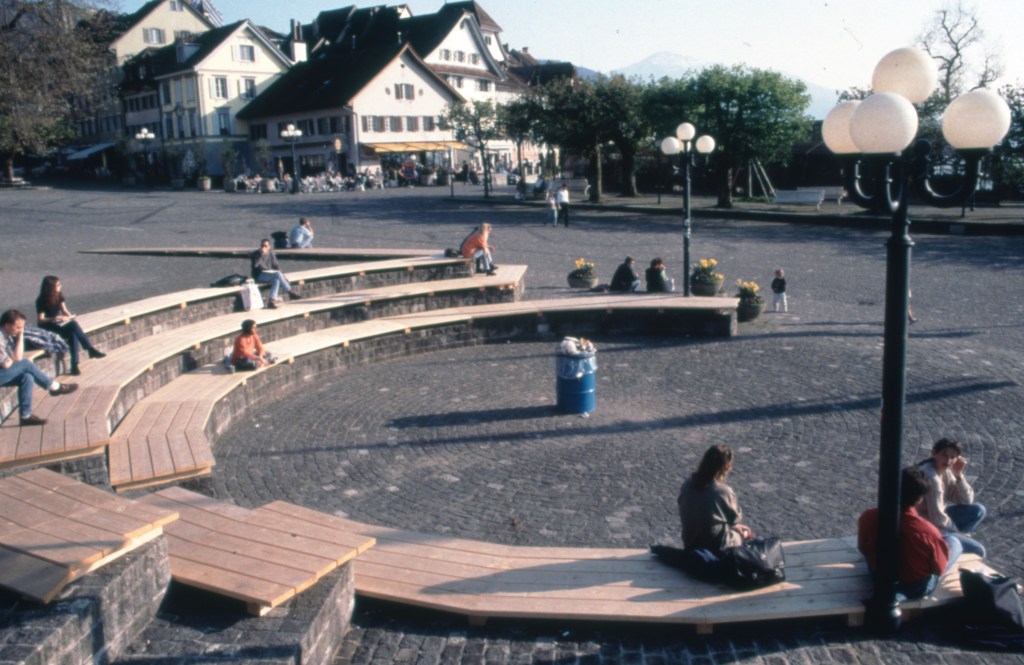
Work in Progress in Zug is an extensive long-term project (1996–1999) that focused exclusively on public space, extending the reach of the Kunsthaus Zug beyond its walls and into the urban environment. In collaboration with various institutions and community groups, Kawamata created a wooden pathway with five stations that weave through the city, connecting its inhabitants both to the Kunsthaus and to the surrounding natural landscape. Still publicly accessible today, these include the Passage to the Kunsthaus Zug, the Wooden Circle Benches at Landsgemeindeplatz, a small wooden village at the Zug lakeside bath – consisting of ten bathing huts and a 100-meter-long wooden wall enclosing the site -, a ship landing pier for the Yellow, the school camp vessel operated by the non-profit organization Zug, and the Brüggli Lakeside Promenade: Walkway and Terrace.The project invites visitors to pause and gain new perspectives on the landscape, fostering dialogue and encouraging them to see the familiar anew.
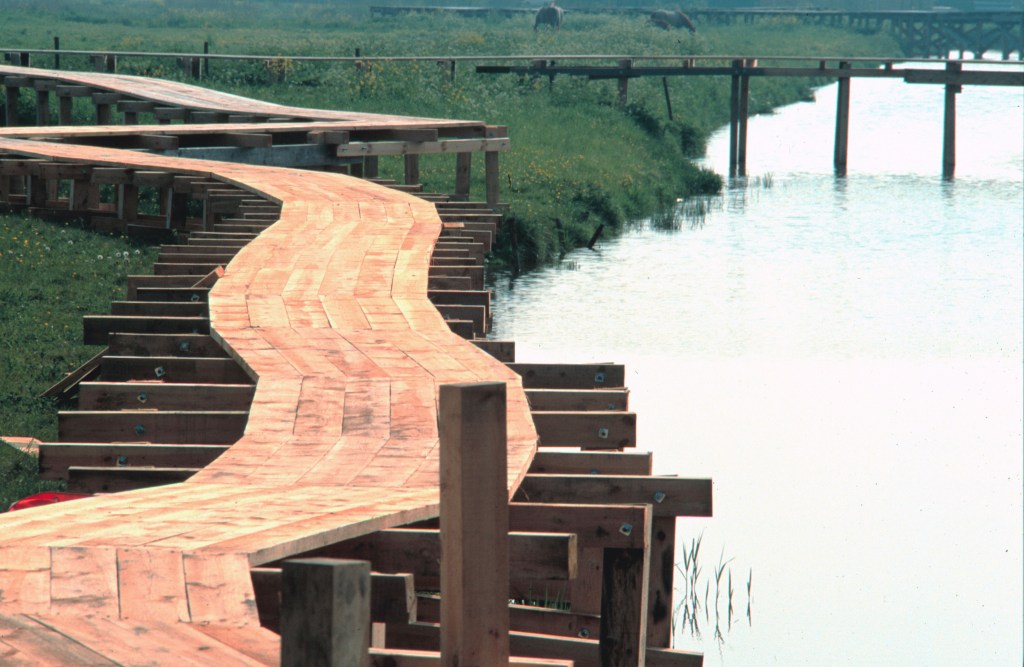
Working Progress
1996 – 1999
Alkmaar, the Netherlands
Working Progress (1996–1999) was a participatory project commissioned by the Brijder Clinic in Alkmaar, an addiction treatment center. Initially invited to create a sculpture for the courtyard of a new facility, Kawamata instead proposed a collaborative project involving the clinic’s patients. Over the course of three years, he worked with them to design and construct a 2-kilometer-long wooden footbridge linking the rehabilitation center to the city, symbolically restoring social connection and a sense of belonging. The collective outdoor construction process fostered engagement, cooperation, and a visible transformation in participants’ attitudes, demonstrating how art can operate as a catalyst for social reintegration through shared activities and creative action.
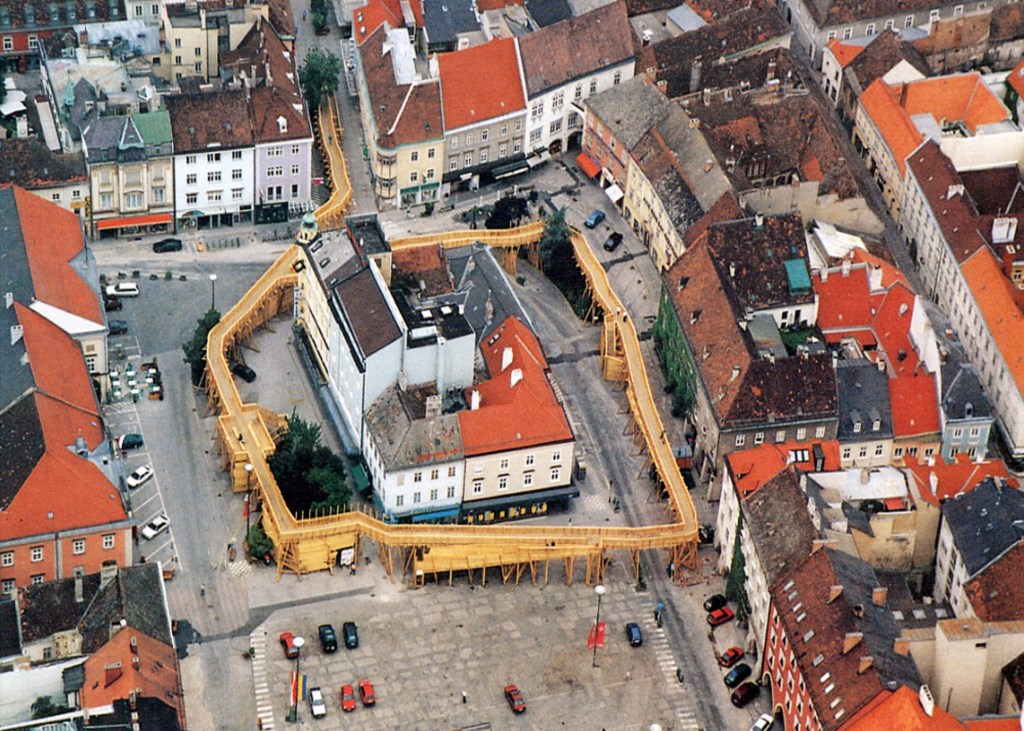
Sidewalk
23 May – 7 July 1996
Hauptplatz, Wiener Neustadt, Wien, Austria.
Sidewalk was an approximately 5-metre-high, 2-metre-wide, and 300-metre-long wooden structure built above the Hauptplatz in Wiener Neustadt. Conceived in response to the large-scale renovation of the city center—then an active construction site with excavations, moving vehicles, and materials being laid and stored—the project provided a temporary elevated walkway for pedestrians. Constructed in about three weeks, the Sidewalk not only allowed people to cross the site safely but also offered a unique vantage point from which to observe the ongoing transformation of the urban landscape.
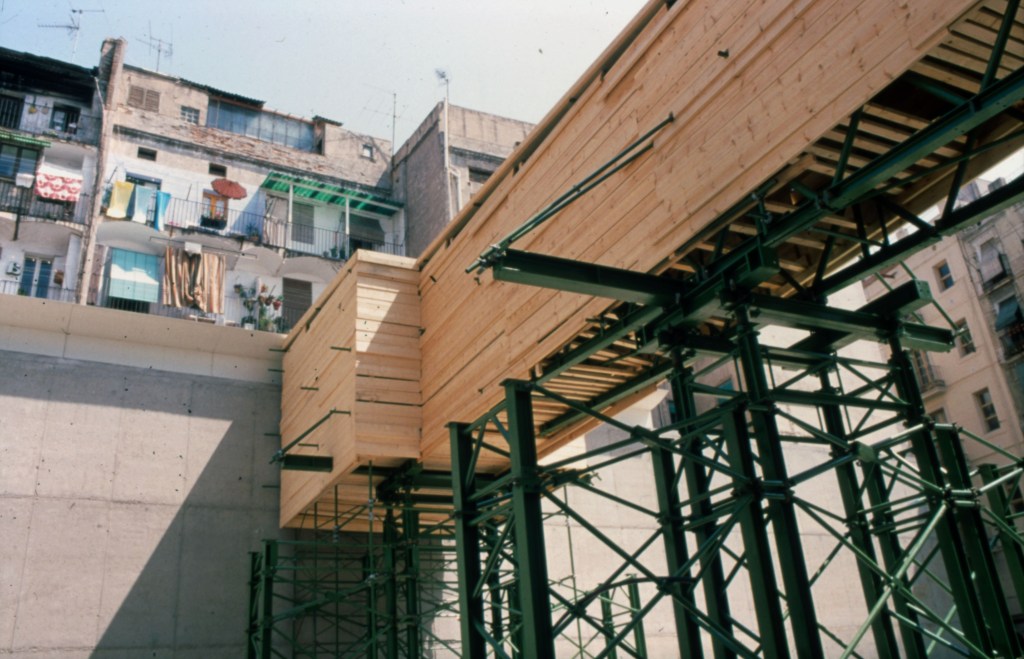
Bridge Walkway
1996
MACBA – Museu d’Art Contemporani de Barcelona, Barcelona, Spain.
Outdoor installation created in the context of the group exhibition Mirades (sobre el Museu)
The exhibition Miradas (sobre el Museo) showcased the work of fourteen local and international artists whose practice emphasized the relationship between installation art and architectural space. Their installations, created both inside and outside Richard Meier’s building, reflected the artists’ personal perspectives on the uses and meanings of exhibition spaces. Kawamata’s intervention consisted of building a pedestrian bridge extending from the gallery toward the adjacent city, simultaneously creating a platform from which to view the buildings overlooking the gallery. In this way, the project established both a physical proximity and a metaphorical connection – and outreach – between the gallery, contemporary art, and the city and its inhabitants.
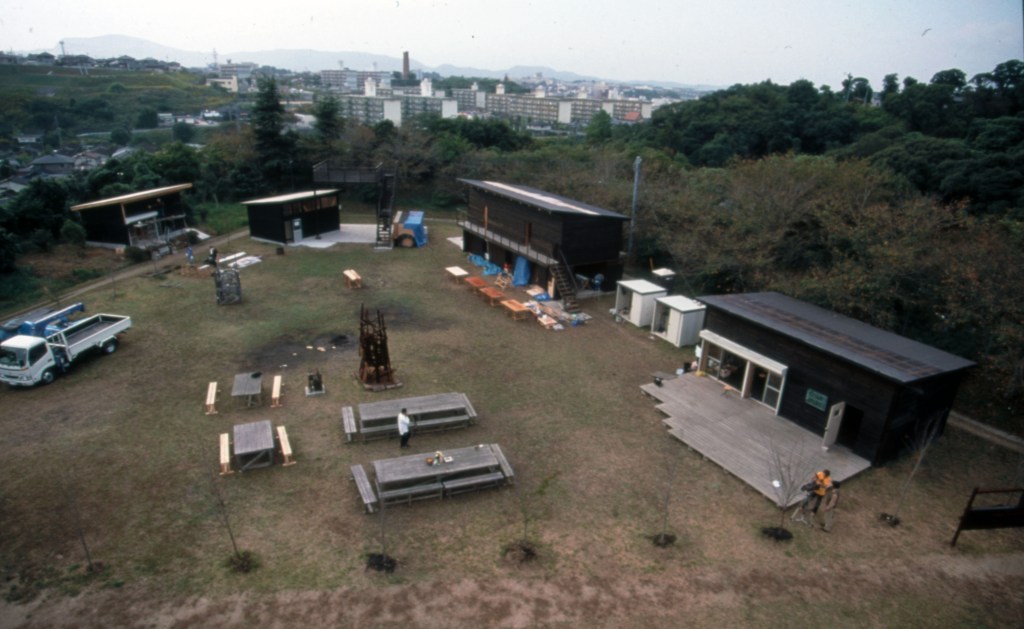
The Coal Mine Project, launched in 1996 in Tagawa, a former coal-mining town in Fukuoka, engages with the legacy of Japan’s industrial modernization. Once central to local economies, sites like Tagawa have become abandoned landscapes – veritable industrial cemeteries – following the decline of coal and steel industries. Kawamata’s engagement with Tagawa is both personal and long-term, reflecting his sustained fascination with coal mines as emblems of industrial power, working-class communities, and sites of post-closure neglect. Conceived as a ten-year initiative, the project aimed to reactivate the town’s historical memory and stimulate dialogue between art, history, and local society. The initial plan envisioned a 50-meter steel tower, gradually constructed over a decade with timbers salvaged from abandoned local railways. The local community was deeply involved, with former miners, students, and residents participating in its assembly. Painted in coal color and evocative of a coal pit, the tower stands as both a monument to the material history of coal and a new symbol of local community identity. Over the years, the project expanded to include social and cultural programming. Seasonal festivals, concerts, and community gatherings transformed the site into a vibrant hub of civic engagement and cultural activity.
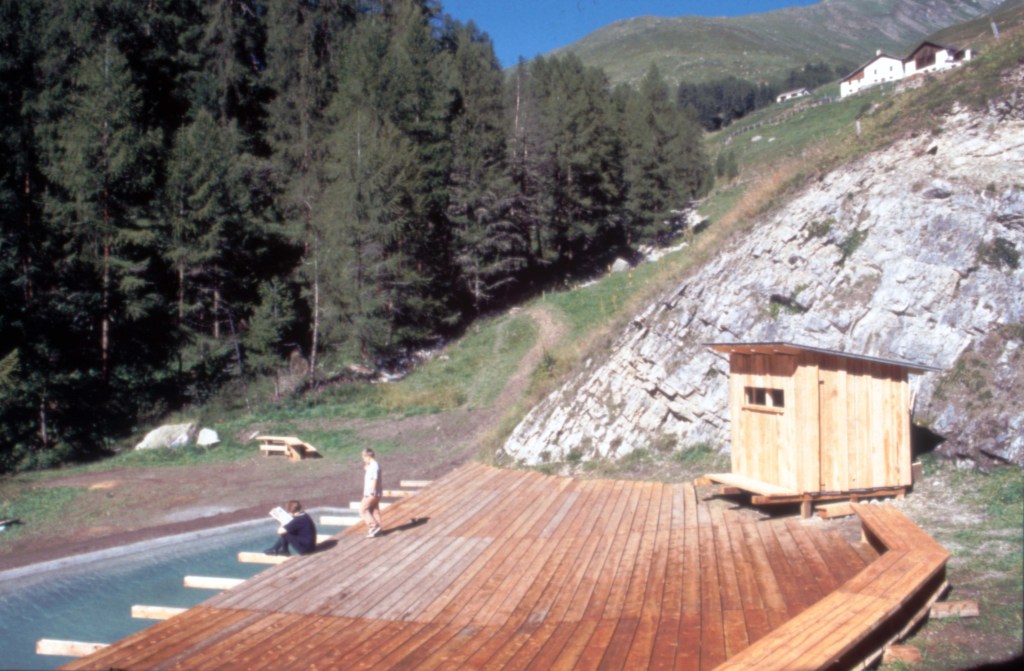
Commissioned by the Castell Zuoz Hotel, Kawamata created a sun deck (Terrasse) and a small rock pool (Felsenbad) with sauna in place of the former swimming pool. Nestled in nature, the new pool area provides an ideal setting for meditation. The two interventions are connected by a wooden passerelle linking the pool to the hotel. Made of reclaimed and raw wood, Kawamata’s installations harmonise with the surrounding environment, evoking a sense of temporality and transience. The project is part of the hotel’s extensive, decades-long art program, which houses Ruedi Bechtler’s substantial contemporary art collection, spanning diverse media from video art to installations, including James Turrell’s Skyspace Piz Uter.
Working Progress: Boat Travelling
1997
From Alkmaar, The Netherlands to to Münster, Germany
Temporary installation for the duration of Skulptur. Projekte in Münster 1997.
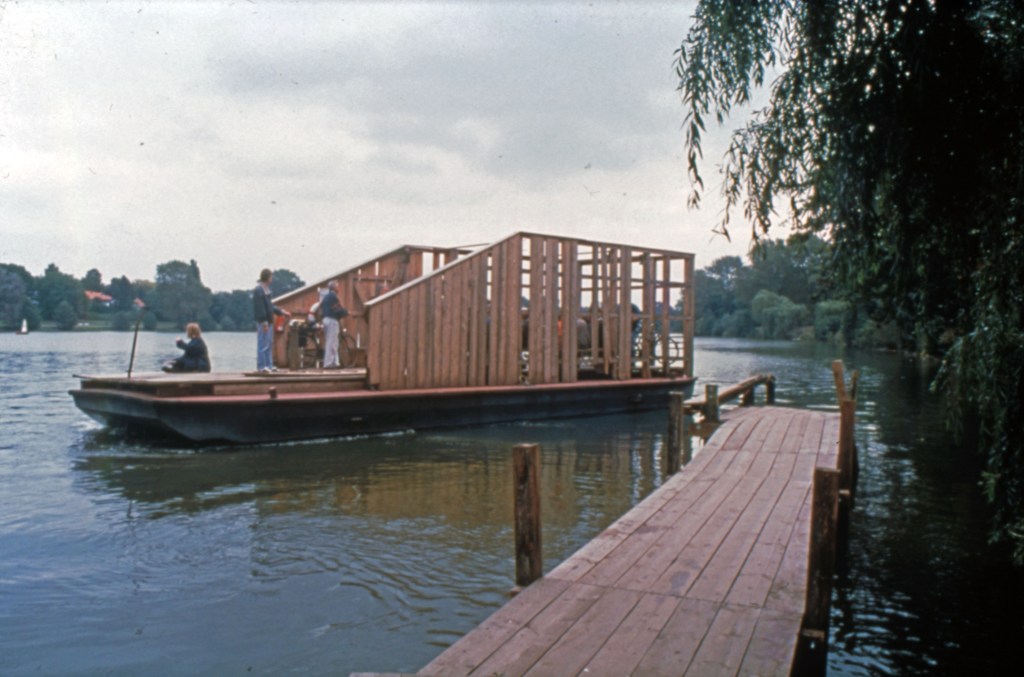
Following the construction of the footpath linking the rehabilitation hospital to the city of Alkmaar, the continuation of the collaborative project with the Brijder Clinic reflected Kawamata’s ambition to extend both its physical and social dimensions. Supported by the Mondriaan Foundation, rehabilitation patients built a jetty and a flat boat—conceived as a floating extension of the original walkway—allowing them to navigate the local canal. The initiative later evolved into an international collaboration through Kawamata’s participation in Skulptur Projekte Münster 1997, the decennial exhibition of outdoor sculpture by international artists. Traveling with the patients by boat from Alkmaar to Münster, the group constructed a wooden walkway along Lake Aasee, connected to its southern terraces, and added a jetty at the lake’s southwestern end. A boat commissioned in Alkmaar provided transport between the Münster sites throughout the exhibition, offering visitors insight into the project’s social context while enabling patients to reengage with society through direct, participatory action.
Relocation
1997
Serpentine South Gallery, London, UK
As part of the exhibition series Inside Out organised by the Serpentine Galleries.
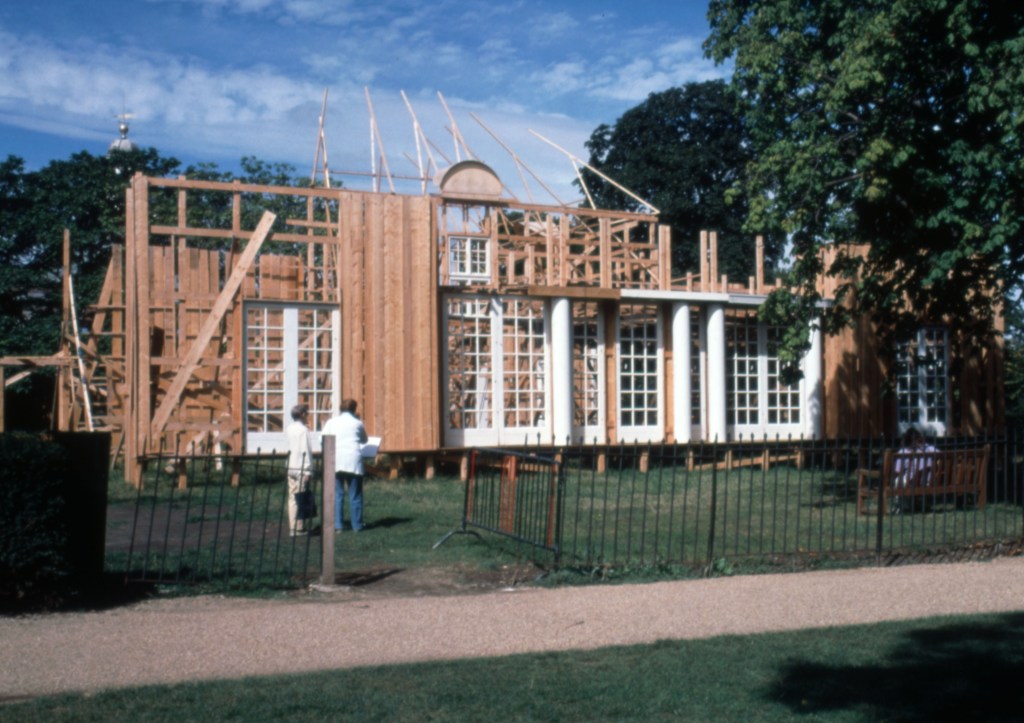
During the interior renovation of the Serpentine South Gallery, five international artists were invited to exhibit on the gallery’s lawn as part of the Inside Out project. The final installation was by Tadashi Kawamata, who created a large-scale structure replicating the exact dimensions of the gallery building. On view from July 1st to September 7th, 1997, the work was constructed using materials salvaged from the renovation process, including the gallery’s original doors and windows. Concurrently, Annely Juda Fine Art hosted an exhibition by Kawamata featuring an installation made from the same reclaimed materials sourced from the renovation site.
Le Passage des chaises
1997
Chapelle Saint-Louis, Hôpital de la Salpêtrière, Paris, France
On the occasion of the Festival d’Automne à Paris (19 September – 2 November 1997)
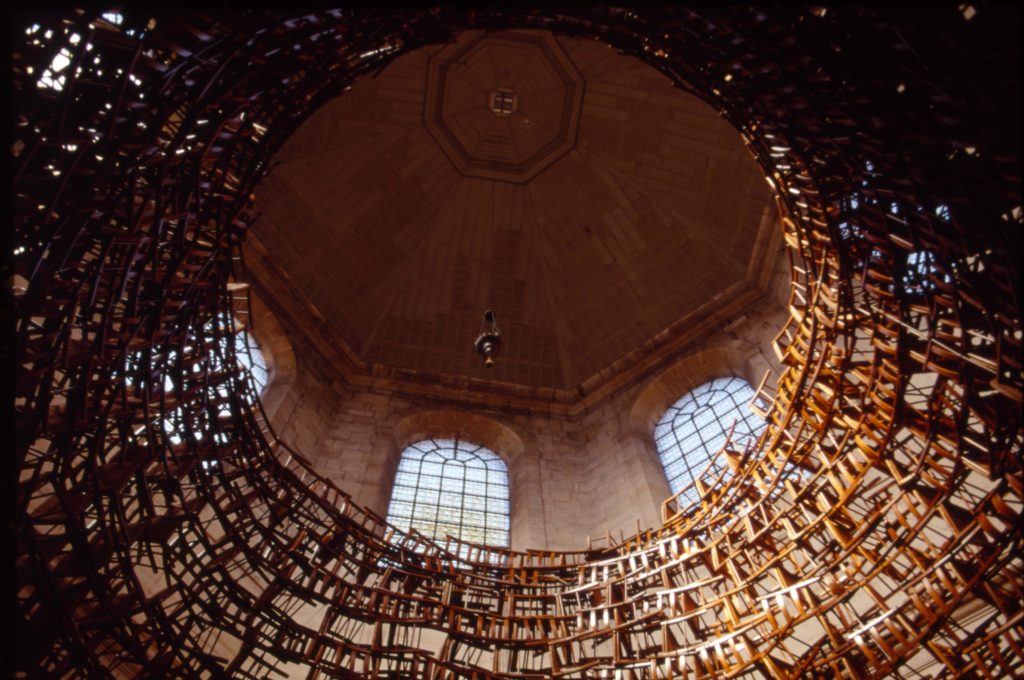
Le Passage des chaises is a site-responsive and temporary installation by Tadashi Kawamata, realised at the Saint-Louis de la Salpêtrière Chapel—situated at the heart of La Salpêtrière Hospital—on the occasion of the Festival d’Automne in Paris. Inspired by his observation of people moving between hospital buildings through the chapel, Kawamata conceived the work to emphasise the space as a site of passage and reflection: a threshold and meeting point for doctors, patients, and visitors navigating the church daily, each carrying their own stories. Beneath the vaulted arch, Kawamata constructed a ten-meter-high helical tower of approximately eight thousand reclaimed prayer stools, benches, and chairs sourced from churches across France, stacked to form a totemic structure rising toward the dome at the intersection of the transept and nave. Its open, web-like composition allowed zenithal light to filter through the gaps, illuminating the humble materials and, together with the chapel’s silence and solemnity, evoking a sense of spiritual ascent and a mystical dimension. By directing the viewer’s gaze upward, the installation offered a renewed perception of the surrounding architecture, transforming the experience of the space and highlighting its contemplative, intimate quality.
“Each of these chairs has a different character with its own story; it is a bit as if people were being connected to one another with plastic ties, and yet it is very solid.” TK
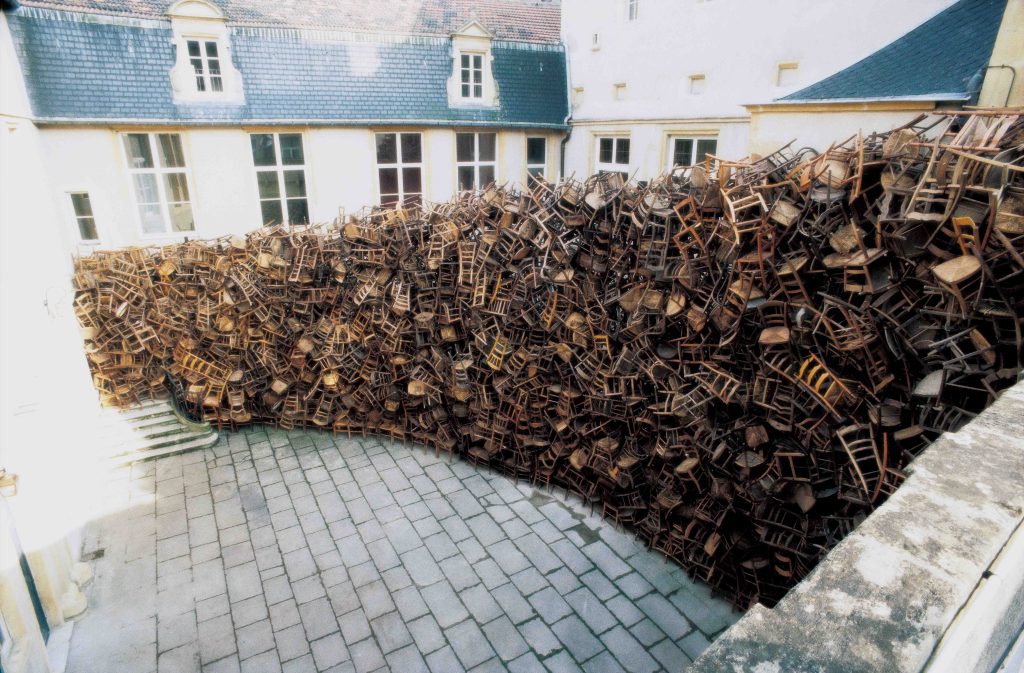
Le chaises de traverse
28 June – 31 October 1998
Centre d’Art Contemporain – La Synagogue de Delme, Delme ; Hôtel Saint-Livier, Metz, France
Organized across two distinct sites – the Centre d’Art Contemporain, La Synagogue de Delme, and the Hôtel Saint-Livier in Metz – the exhibition Les chaises de traverse revisits the medium of the chair to present two monumental installations that, despite their scale, retain a profoundly human dimension. This is evoked through the quotidian nature of the chair, one of the most archaic and domestic of objects, designed to human scale, supporting the body, and intimately linked to everyday life. The chair thus serves as both a symbolic and physical embodiment of humanity—reflecting the fragility of the individual while simultaneously conveying the solidity and resilience of collective human existence. Approximately 4,000 chairs were arranged vertically along a wall several meters high, spanning both the exterior of the building and its inner courtyard in Metz, while in the gallery at Delme they were suspended horizontally in a wave-like formation. By interrupting the connection between the two levels of the Synagogue, Kawamata introduces a new spatial division, inviting viewers to perceive the environment in a novel way, while simultaneously reflecting on its historical context and evoking the former hierarchical separation of men and women.
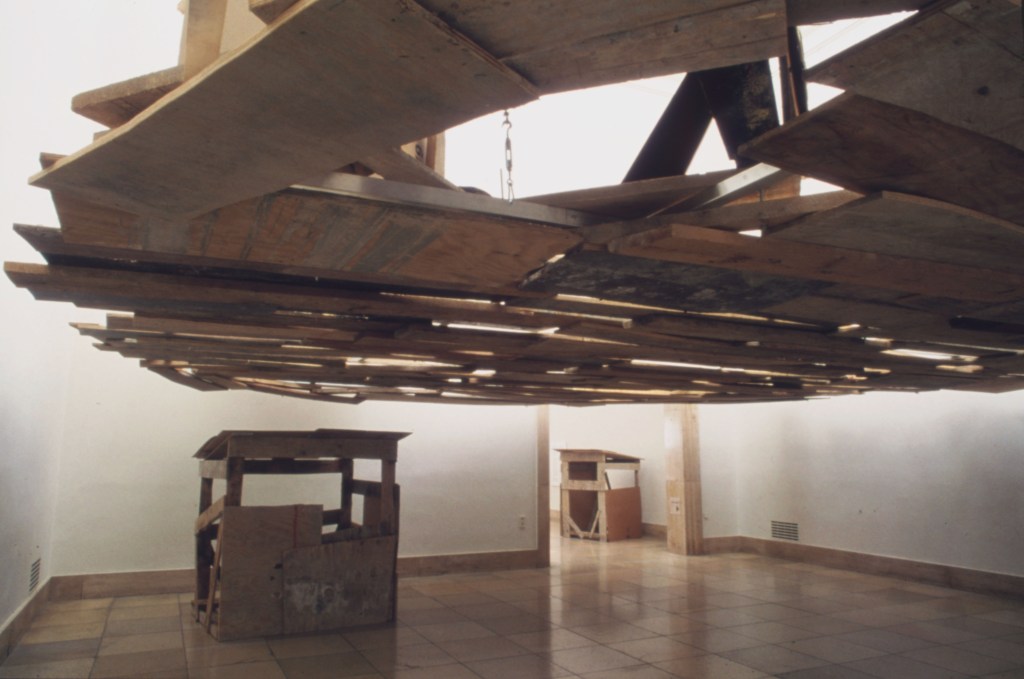
Haus der Kunst
29 July – 27 September 1998
Staatsgalerie Moderner Kunst, Munich, Germany.
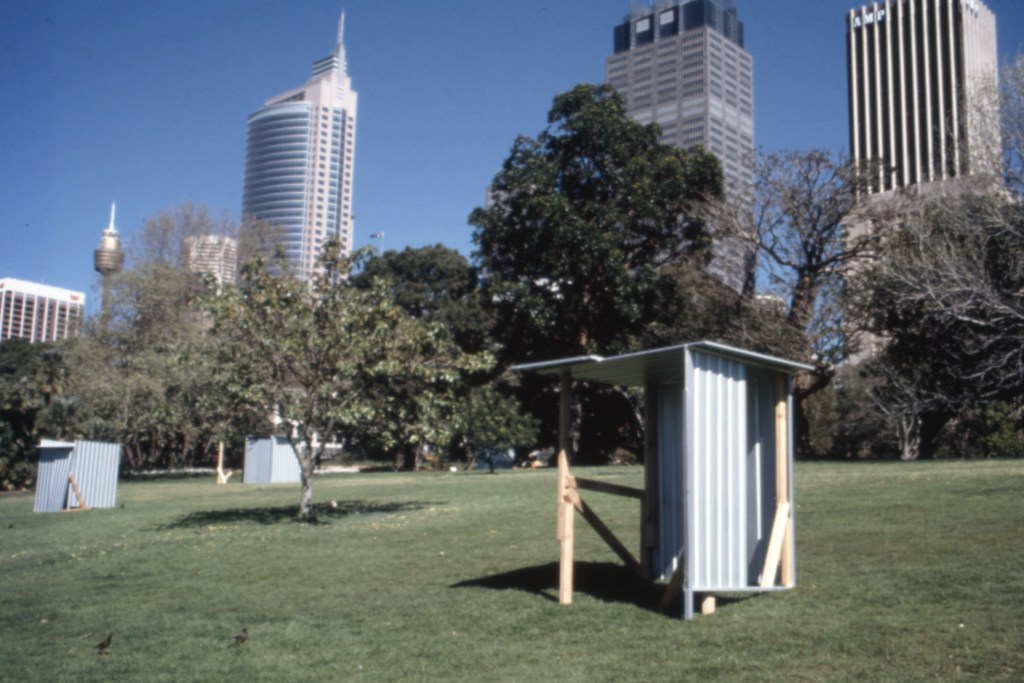
Garden Sheds
18 September – 8 November 1998
Royal Botanic Garden, Sydney, Australia.
Outdoor installation on the occasion of the 11th Biennale of Sydney “Everyday”
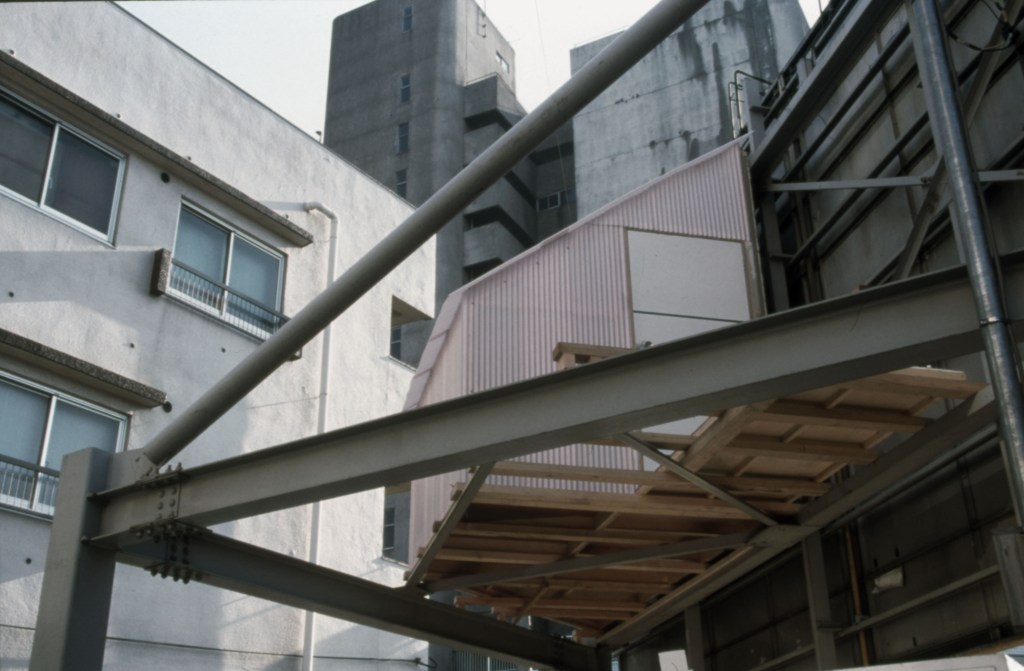
Tokyo Project: New Housing Plan
1998
Tokyo, Japan
Tokyo Project – New Housing Plan investigates the complex reality of housing and the diverse ways of living and working within a metropolis as vast and dense as Tokyo. The project reflects on how city dwellers adapt to limited space and constant movement in one of the world’s most compressed urban environments. In a series of forgotten corners of the city – between construction-site fences, behind vending machines, or hidden behind billboards – Kawamata appropriated consumerist sites and structures to construct a set of small, parasitic shelters. Each temporary dwelling was inhabited in rotation for a week by Kawamata and other artists.
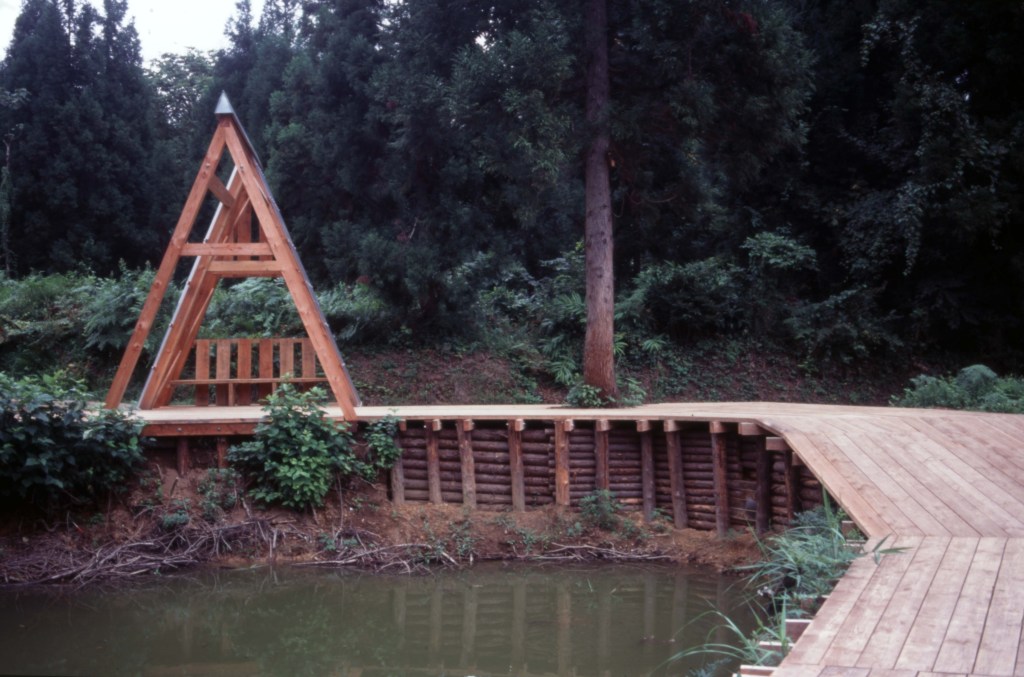
Matsunoyama Project
1999 -2003
Tōkamachi City, Niigata Prefecture, Japan
The long-term, site-specific Matsunoyama Project was initiated in 1999 in Matsunoyama, a mountainous region of Tōkamachi City in Niigata Prefecture. Within the broader framework of the Echigo-Tsumari Art Triennale, which aims to revitalize depopulated rural communities through contemporary art, Kawamata collaborated with local residents, students, and volunteers to create a series of artistic and community-based interventions in the forested landscape surrounding Matsunoyama. Through a series of workshops organized over a five-year period, wooden walkways, rest shelters, and small cleared areas were created in the forest, and thirty small unmanned stalls were set up along roads and in hamlets. The project demonstrated how sustainable, long-term art practices can not only create thoughtful, functional installations that respond to the environment, but also foster evolving social and spatial relationships.
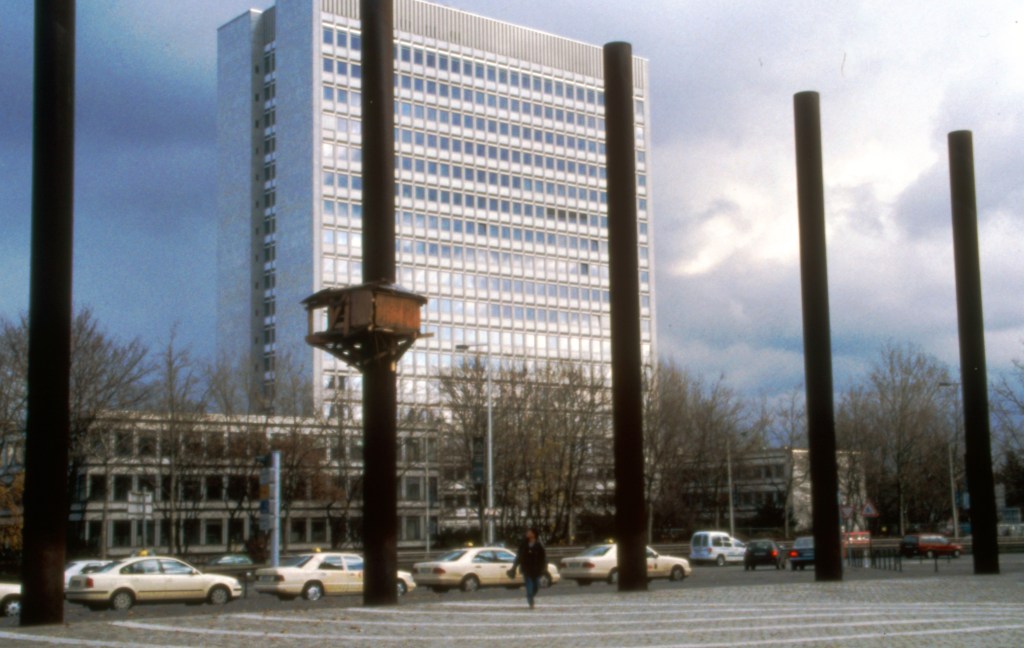
Tree Hut
1999
Kunstmuseum Bonn, Bonn, Germany.
Installation of a wooden hut onto an existing steel pylon in the Museumsmeile area, as part of the two-location group exhibition Zeitwenden – Ausblick organised by the Stiftung für Kunst und Kultur e.V. and the Kunstmuseums Bonn.
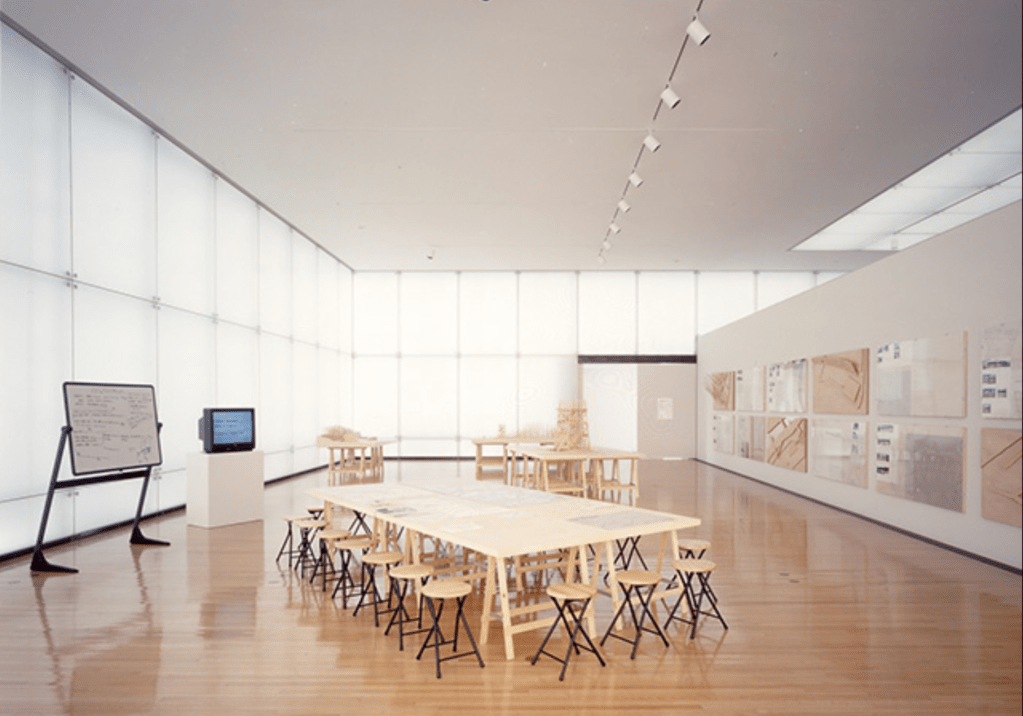
Work in Progress, Project in Toyota
1999 – 2003
Toyota, Japan
Organised by Toyota Municipal Museum of Art.
